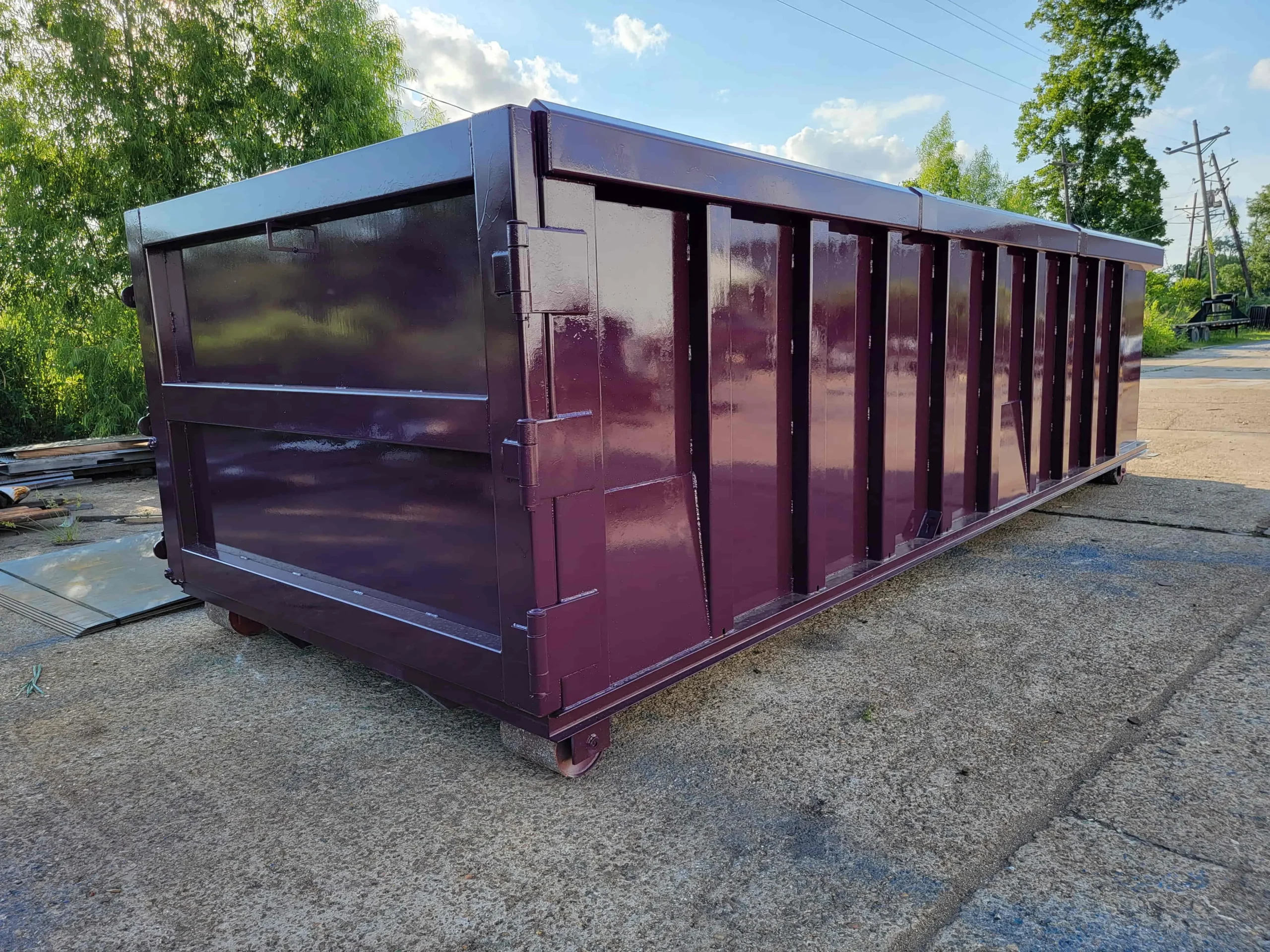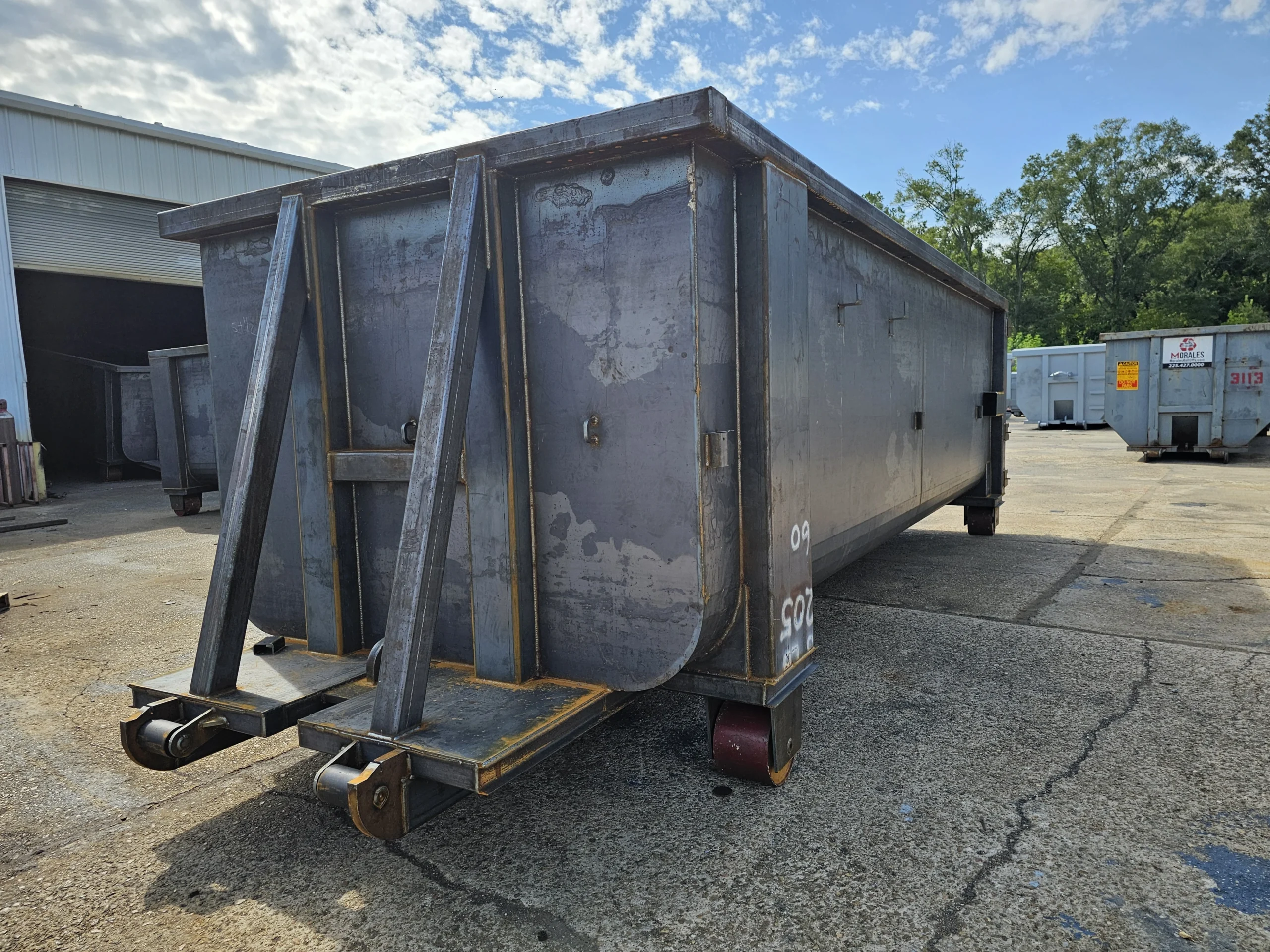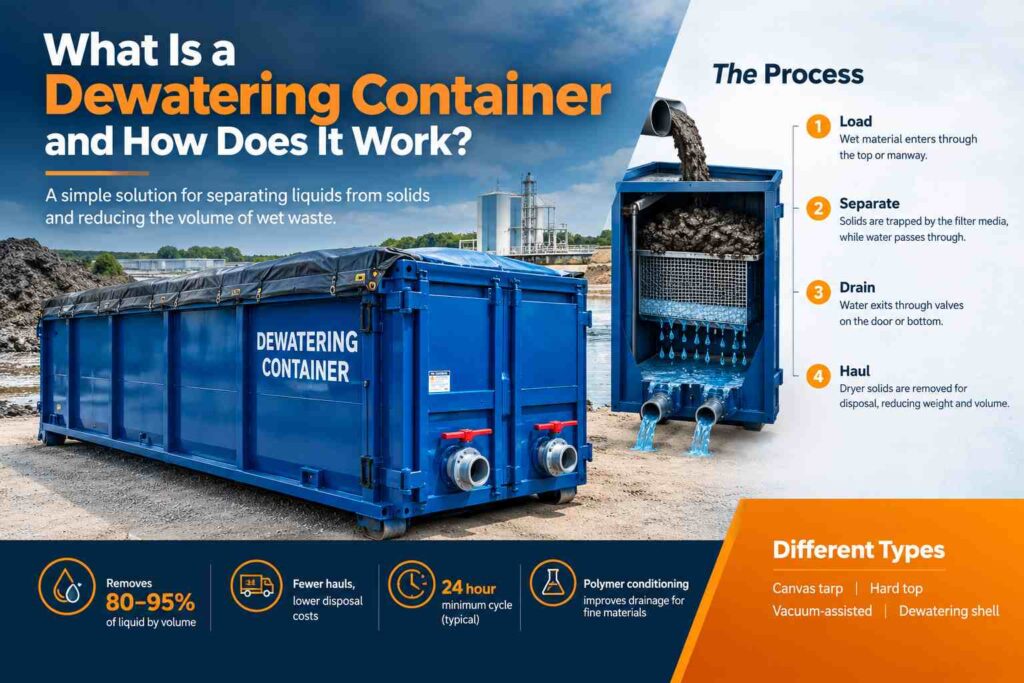
A dewatering container is a sealed steel roll-off container with an internal filtration system built to separate liquids from solids. Wet sludge, slurry, or saturated material goes in through the top. Water passes through the filter media and drains out through valved discharge points on the door or bottom. The solid material stays trapped inside. Municipal wastewater plants, petrochemical facilities, construction sites, and dredging operations all use dewatering containers to reduce the weight and volume of wet waste before hauling it to disposal. You may also hear them called dewatering boxes, sludge containers, or dewatering roll-offs.
How Does a Dewatering Container Work?
The process is straightforward, but the details matter if you want the container to perform correctly.
It starts with loading. A pump, vacuum truck, or excavator fills the container with wet material through an open top or manway. Sludge, slurry, drilling mud, sediment, wash water with suspended solids. Whatever the waste stream, it enters the container in a liquid or semi-liquid state.
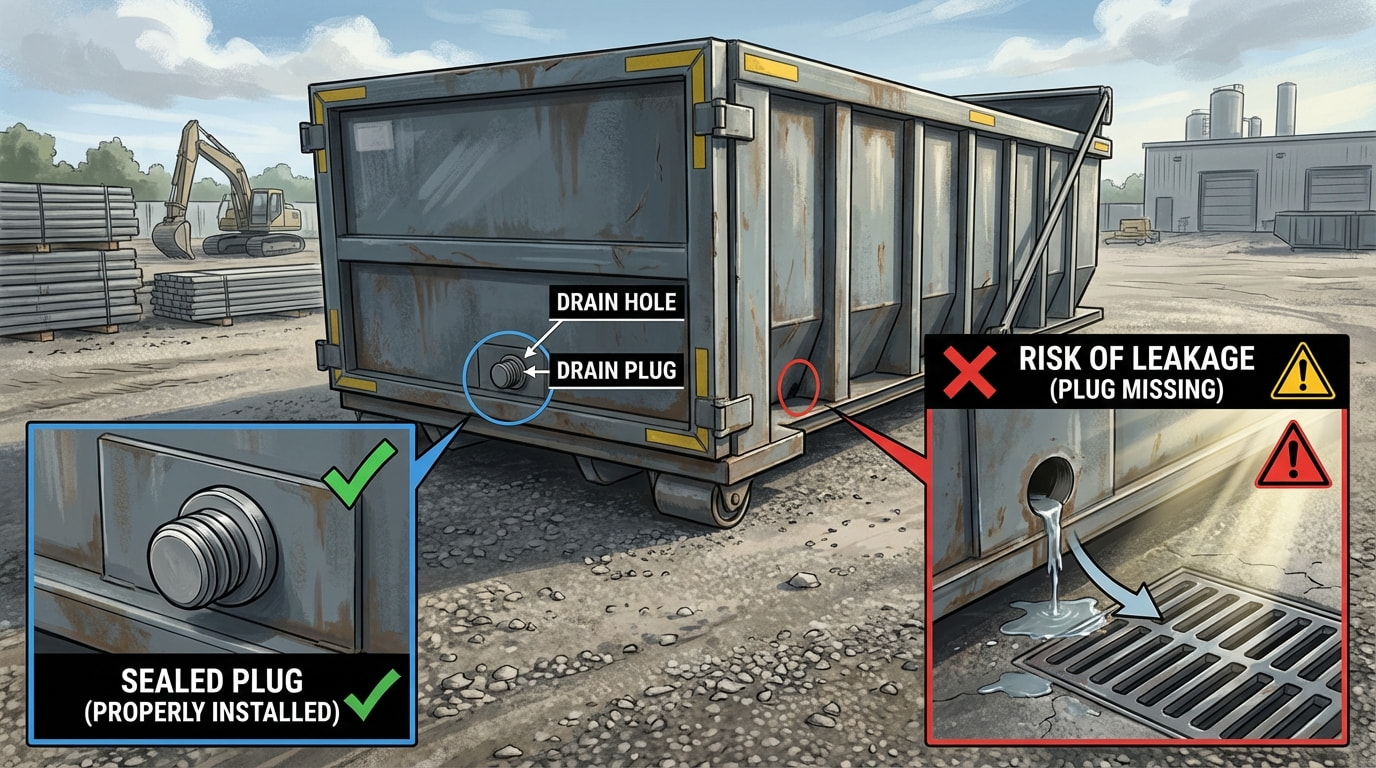
Once loaded, the solids settle against the filter media. The internal cage, basket, or liner traps particles above a certain size while letting water pass through. That water collects in the drain space between the filter and the outer container wall, then exits through 4 inch or 6 inch drain valves on the rear door or floor.
Filling usually takes 6 to 8 hours. Draining takes longer, 16 hours or more after the container is full. The general rule is to plan for a 24 hour minimum cycle from the start of filling to the point where the solids are dry enough to pass the paint filter test and get hauled to a landfill.
Depending on the solids content of the incoming material, dewatering removes 80 to 95 percent of the liquid by volume. That translates directly into fewer hauls, lighter loads, and lower disposal costs.
One variable that changes drainage performance is polymer conditioning. Adding a flocculant to the slurry before it enters the container causes fine particles to clump into larger masses that settle faster and release water more easily. Treatment costs roughly $0.002 to $0.005 per gallon. Coarse materials like sand and gravel drain well without it. But for municipal sludge and fine industrial waste, polymer conditioning makes a measurable difference in cycle time and cake dryness.
Types of Dewatering Containers
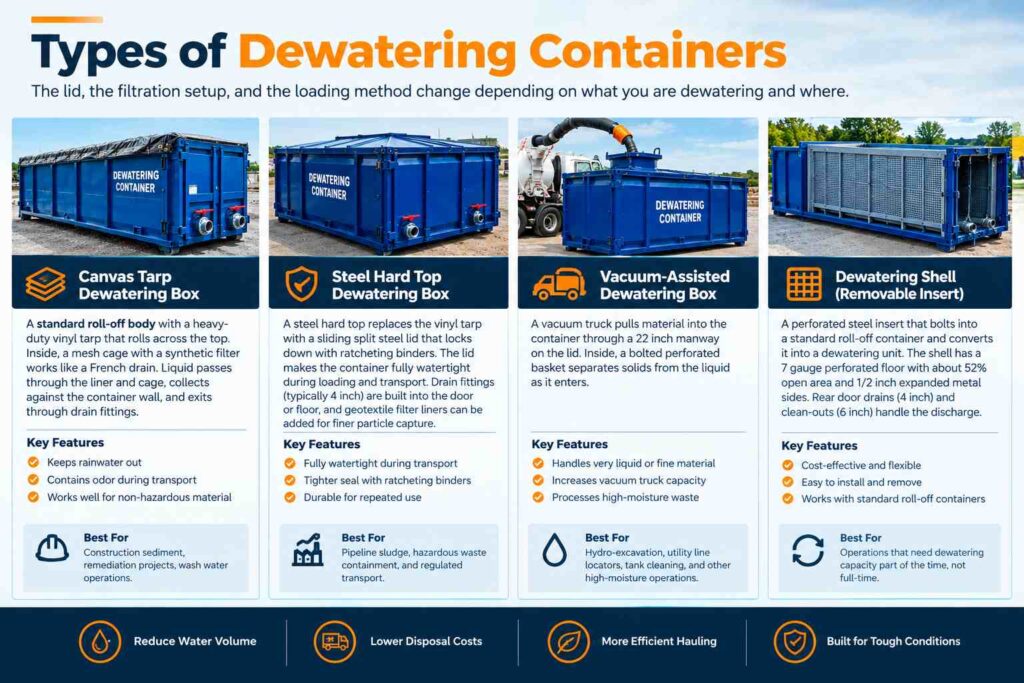
The lid, the filtration setup, and the loading method change depending on what you are dewatering and where.
Canvas Tarp Dewatering Box
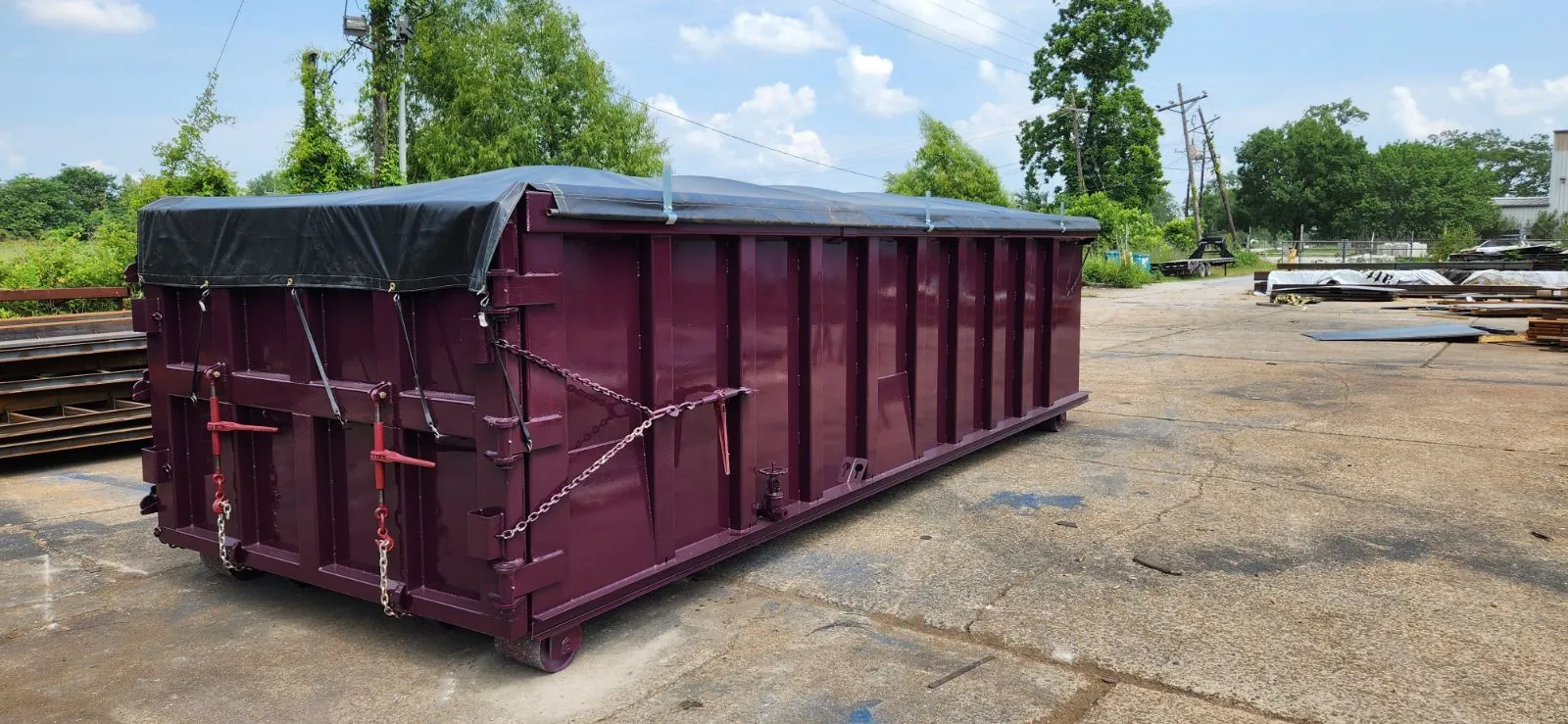
This is a standard roll-off body with a heavy-duty vinyl tarp that rolls across the top. Inside, an internal mesh cage lined with a synthetic filter works like a French drain. Liquid passes through the liner and cage, collects against the container wall, and exits through drain fittings.
The tarp keeps rainwater out during the dewatering cycle. Rain adds volume, dilutes the sludge, and extends drain time. It also contains odor during transport, which matters on urban job sites and near residential areas. Canvas tarp dewatering boxes work well for construction sediment, remediation projects, and wash water operations where the material is not classified as hazardous.
Steel Hard Top Dewatering Box
A steel hard top replaces the vinyl tarp with a sliding split steel lid that locks down with ratcheting binders. The lid makes the container fully watertight during both loading and transport. Drain fittings (typically 4 inch) are built into the door or floor, and operators can add geotextile filter liners inside the cage for finer particle capture.
Hard top boxes are the standard choice for pipeline industry sludge, hazardous waste containment, and any application where regulations require a sealed container during transport. The steel lid holds up better than a tarp under repeated use, and the ratcheting binders create a tighter seal.
Vacuum-Assisted Dewatering Box
Vacuum boxes are loaded differently. Instead of filling from the top, a vacuum truck pulls material into the container through a 22 inch manway on the lid. Inside, a bolted perforated basket separates solids from the liquid as it enters.
This setup handles materials that are too liquid or too fine for gravity filling. It also lets vacuum trucks extend their capacity by offloading into the dewatering container on site, then going back to work instead of driving to a disposal facility. Hydro-excavation crews, utility line locators, and industrial tank cleaning operations use vacuum dewatering boxes because they process high-moisture material that resists gravity drainage alone.
Dewatering Shell (Removable Insert)
A dewatering shell is not a standalone container. It is a perforated steel insert that bolts into a standard roll-off container and converts it into a dewatering unit. A typical shell has a 7 gauge perforated floor with about 52 percent open area and 1/2 inch flat expanded metal sides held in place with J hooks. Rear door drains (4 inch) and clean-outs (6 inch) handle the liquid discharge.
This option works for operations that need dewatering capacity part of the time but do not want to dedicate a container to it full-time. When the job is done, the shell unbolts and the container goes back to hauling dry waste.
How Dewatering Containers Are Built
Dewatering containers need heavier construction than standard open-top roll-offs. Water weighs approximately 1,685 pounds per cubic yard, and a 25 yard container filled with wet sludge pushes well past the weight of dry construction debris at the same volume. That weight sits in the container for 24 hours or longer. Hydrostatic pressure from the liquid presses outward against the sidewalls and downward on the floor for the entire duration. A container built to standard duty specs will bow at the sidewalls, stress the welds, and eventually leak.
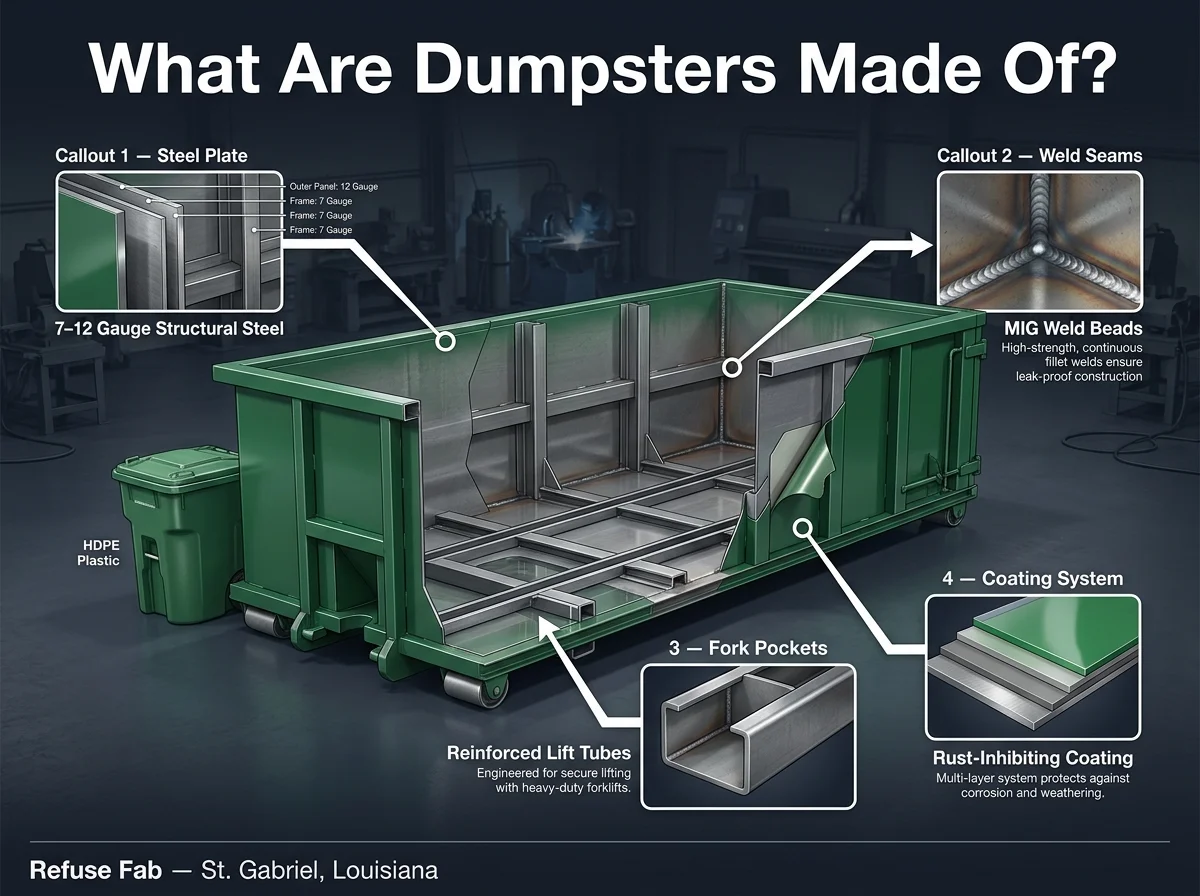
Standard dewatering specs call for 7 gauge sidewalls and 1/4 inch floor plate. Some configurations use 10 gauge sides with a 3/16 inch floor for lighter applications, but the heavier build is more common because most dewatering loads are dense and wet.
Underneath, 6 inch by 2 inch by 1/4 inch tubing long sills carry the load. Cross members are 3 inch channel on 16 inch centers, and the floor slopes toward the rear drain points so gravity moves filtrate toward the discharge fittings.
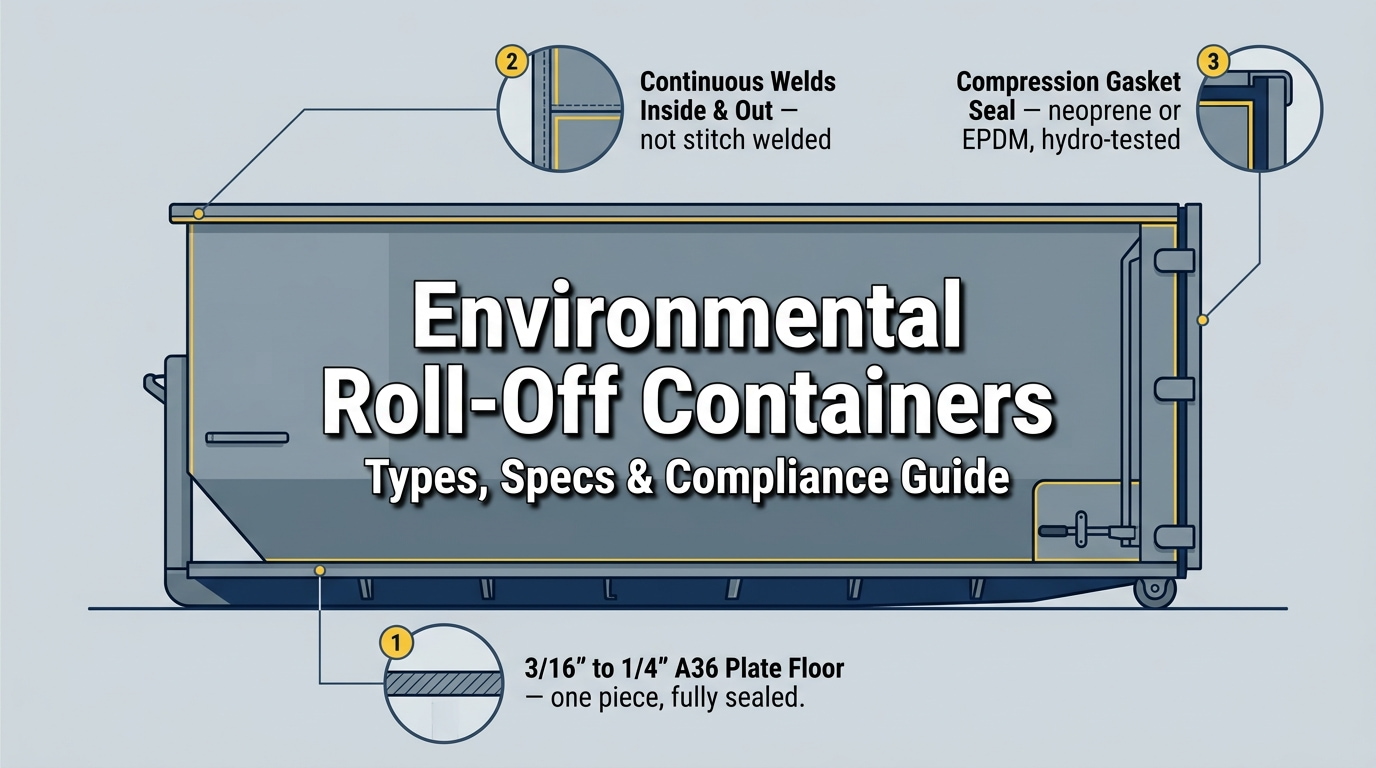
Every dewatering container we build is continuously welded on all interior and exterior seams. Stitch welding leaves gaps that become leak points under hydrostatic pressure. After welding, every container is hydro-tested. We fill it with water and inspect every weld for leaks before it ships.
The rear door uses EPDM or neoprene gaskets in a T-box seal design. The door also carries the drain valves, typically butterfly valves or blind flanges that give the operator control over drainage. Rollers are 8 inch OD greaseable units rated for the heavier loaded weight that dewatering containers carry.
Permanent vs Disposable Dewatering Filters
The filtration system inside a dewatering container determines what particles get captured, how fast the water drains, and how much maintenance the container requires between cycles.
Permanent Filter Systems
Permanent filters use a metal support structure with a fixed screen. The support is typically bar grating, expanded metal, or perforated plate. Over that sits a stainless steel or galvanized mesh that does the actual filtering. Bar grating gives you the most open area and highest flow rate. Expanded metal balances strength with good drainage. Perforated plate offers the finest filtration but slows the flow.
A well-maintained permanent filter lasts five years or longer. The upfront cost is higher than disposable media, but the per-cycle cost drops over time because you are not replacing the filter after every load. Pressure washing the screen between cycles and inspecting the support structure for damage keeps performance consistent. Permanent filters work best for continuous operations with a consistent waste stream where particle size and volume stay relatively stable from load to load.
Disposable Filter Systems
Disposable filters use needle-punched polypropylene geotextile fabric installed as a liner inside the cage or basket. After each cycle, the used liner gets pulled out with the solids and the container gets a fresh liner for the next load.
Per-cycle cost is higher, but disposable liners capture finer particles than most permanent screens and produce cleaner filtrate. For operations that need to meet strict discharge quality standards, disposable geotextile is often the better choice. They also make sense for one-time projects and varying waste streams where the material changes frequently enough that a single permanent filter cannot handle everything.
Refuse Fab builds dewatering and sludge containers with both permanent and removable cage and filter configurations, installed to match the material you need to process.
Where Dewatering Containers Are Used
Any operation that generates wet waste with recoverable solids is a candidate for container-based dewatering.
Municipal wastewater treatment is the largest market. Sludge from clarifiers, digesters, and lagoon cleanouts goes into dewatering containers to reduce volume before landfill disposal.
Petrochemical and industrial facilities produce process sludge, tank bottoms, and wash water with suspended solids. Refineries, chemical plants, and manufacturing operations along Louisiana’s industrial corridor use dewatering containers regularly. This is Refuse Fab’s home market. We build containers for these operations and understand the regulatory requirements that come with petrochemical waste.
Construction and excavation sites deal with stormwater sediment, hydro-excavation slurry, and concrete washout. Dewatering on site before hauling cuts weight and cost on every load. Dredging operations pump sediment from rivers, lakes, retention ponds, and harbors where the pumped material is mostly water.
Environmental remediation projects process contaminated soil slurry and groundwater treatment residuals. The filtrate from these operations often requires testing before discharge.
Regulatory Requirements for Dewatering Operations
This is the part that most equipment suppliers skip, but it matters just as much as the container itself.
EPA Paint Filter Liquids Test (Method 9095B)
Before dewatered solids can go to a landfill, they must pass the paint filter test. This is a federal requirement. A sample of the dewatered material is placed in a standard paint filter cone. If any liquid passes through within five minutes, the material fails. Most municipal solid waste landfills do not accept material with free liquids.
The solids inside your dewatering container must be dry enough to pass this test before you haul them. If they are too wet, you either extend the drain cycle, add polymer to improve dewatering, or use a finer filter media.
NPDES Discharge Permits
Under the Clean Water Act, you cannot discharge filtrate into storm drains, ditches, streams, or onto the ground without a National Pollutant Discharge Elimination System (NPDES) permit. The permit specifies acceptable pollutant levels and sets monitoring requirements. State regulations add another layer. In Louisiana, discharge rules fall under LAC 33:V.
Some operations avoid the permit by collecting filtrate in a tank and hauling it to a licensed treatment facility. If your operation will discharge liquid to any waterway or storm system, get the permit before you start. Our environmental roll-off containers blog covers the broader regulatory framework (RCRA, DOT, OSHA HAZWOPER) for hazardous waste operations.
Container Compliance
For hazardous waste, the container itself must meet RCRA standards under 40 CFR 264/265 (fully sealed construction, proper labeling, documented inspection protocols) and DOT regulations (49 CFR 172/173) for transport. Every environmental and dewatering container we produce is fully welded and hydro-tested, which satisfies the containment integrity requirements under both RCRA and DOT.
Dewatering Container Sizes
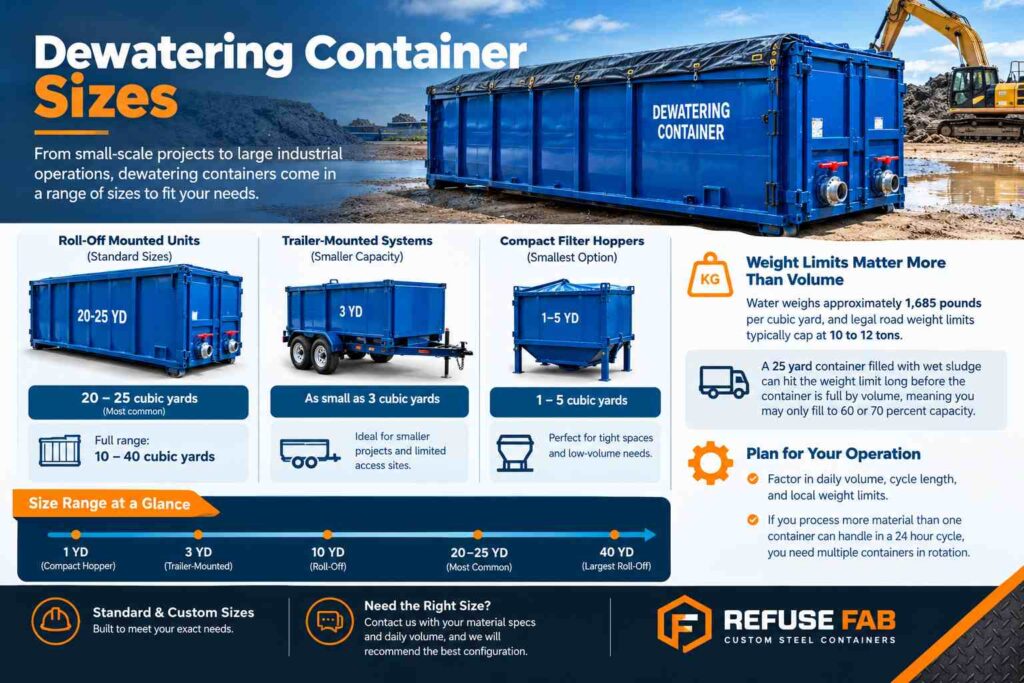
Most dewatering containers in the field are 20 or 25 cubic yards. The full range runs from 10 to 40 cubic yards for roll-off mounted units, with trailer-mounted systems as small as 3 cubic yards and compact filter hoppers at 1 to 5 cubic yards.
Weight limits matter more than volume with dewatering containers. Water weighs approximately 1,685 pounds per cubic yard, and legal road weight limits typically cap at 10 to 12 tons. A 25 yard container filled with wet sludge can hit the weight limit long before the container is full by volume, meaning you may only fill to 60 or 70 percent capacity.
Factor in daily volume, cycle length, and local weight limits when choosing a size. If you process more material than one container can handle in a 24 hour cycle, you need multiple containers in rotation.
Refuse Fab builds dewatering containers in standard and custom sizes. Contact us with your material specs and daily volume, and we will recommend the right configuration.
How to Choose the Right Dewatering Container
Seven factors drive the decision.
Start with the material. Coarse solids like sand and gravel separate easily with a permanent mesh filter and gravity drainage. Fine particles like municipal sludge or drilling mud need finer filtration and may benefit from polymer conditioning or vacuum assist.
Particle size determines filter type. If your solids pass through a standard mesh screen, you need geotextile liners or a finer permanent filter. Test a sample before committing to a filtration setup.
Most operations run gravity drainage. Vacuum assist is worth the added cost for high-moisture sludge and fine particles that resist gravity drainage.
Consider the lid. Rain intrusion extends dewatering time. Odor control matters on populated job sites. Hazardous material regulations may require a sealed container. If any of these apply, choose a hard top or tarp system.
Daily volume determines container size and rotation. If you fill a 25 yard container in 6 hours and need 18 hours of drain time, you need at least two containers on offset cycles.
Ongoing operations justify permanent filtration. One-time projects or seasonal work may be better served by renting or by using a removable dewatering shell.
Discharge requirements also influence the decision. If you plan to discharge filtrate to a waterway, you need an NPDES permit and your filtrate quality needs to meet the permit limits.
For help matching a dewatering container to your operation, call Refuse Fab at (225) 715-4698 or email sales@refusefab.com. We build every configuration discussed in this guide, and we can spec a container to your material, volume, and regulatory requirements.
Frequently Asked Questions About Dewatering Containers
What is the difference between a dewatering container and a sludge container? A sludge container holds wet sludge in a sealed box for transport. A dewatering container actively separates liquid from solids through a filtration system. Some containers do both. A sealed environmental container with a removable dewatering cage operates as a sludge container when the cage is out and a dewatering container when it is installed.
How long does dewatering take? Plan for a 24 hour minimum cycle. Filling typically takes 6 to 8 hours, and draining takes 16 hours or more depending on the material. Polymer conditioning can speed drainage on difficult materials. Cold weather slows it.
How much does a dewatering container cost? Pricing ranges from $15,000 to $50,000 depending on size, steel grade, filtration type, lid configuration, and custom options. A 25 yard box with a standard cage and drain fittings falls toward the lower end. A fully custom unit with vacuum-assist plumbing, epoxy coating, and specialized filtration pushes higher.
Can you convert a standard roll-off into a dewatering container? Yes, using a removable dewatering shell. The shell is a perforated steel insert with filter media that bolts into a standard container and converts it into a functional dewatering unit. When the job is done, the shell comes out and the container goes back to normal service.
What is the paint filter test? The EPA Paint Filter Liquids Test (Method 9095B) determines whether waste contains free liquids. A sample goes into a paint filter cone, and if any liquid passes through within five minutes, the waste fails. Your dewatered solids must pass this test before landfill disposal.
Do you need a permit to discharge dewatering water? If you discharge filtrate into any storm drain, ditch, stream, or waterway, you need an NPDES permit under the Clean Water Act. Some operations avoid the permit by collecting filtrate in a tank and hauling it to a treatment facility.
How often do dewatering filters need to be replaced? Permanent metal filters last five years or longer with regular cleaning. Disposable geotextile liners are replaced after each cycle. The choice depends on your waste stream consistency and how frequently the container runs.
What size dewatering container do I need? Start with your daily material volume and weight limits. Most operations use 20 or 25 cubic yard containers, but water weight often maxes out the legal road limit before the container is full by volume. If you process more than one load per day, plan for multiple containers in rotation.
For custom specs, contact the Refuse Fab team or browse our full product line. We build every type of roll-off container from standard open-tops to fully custom dewatering systems.