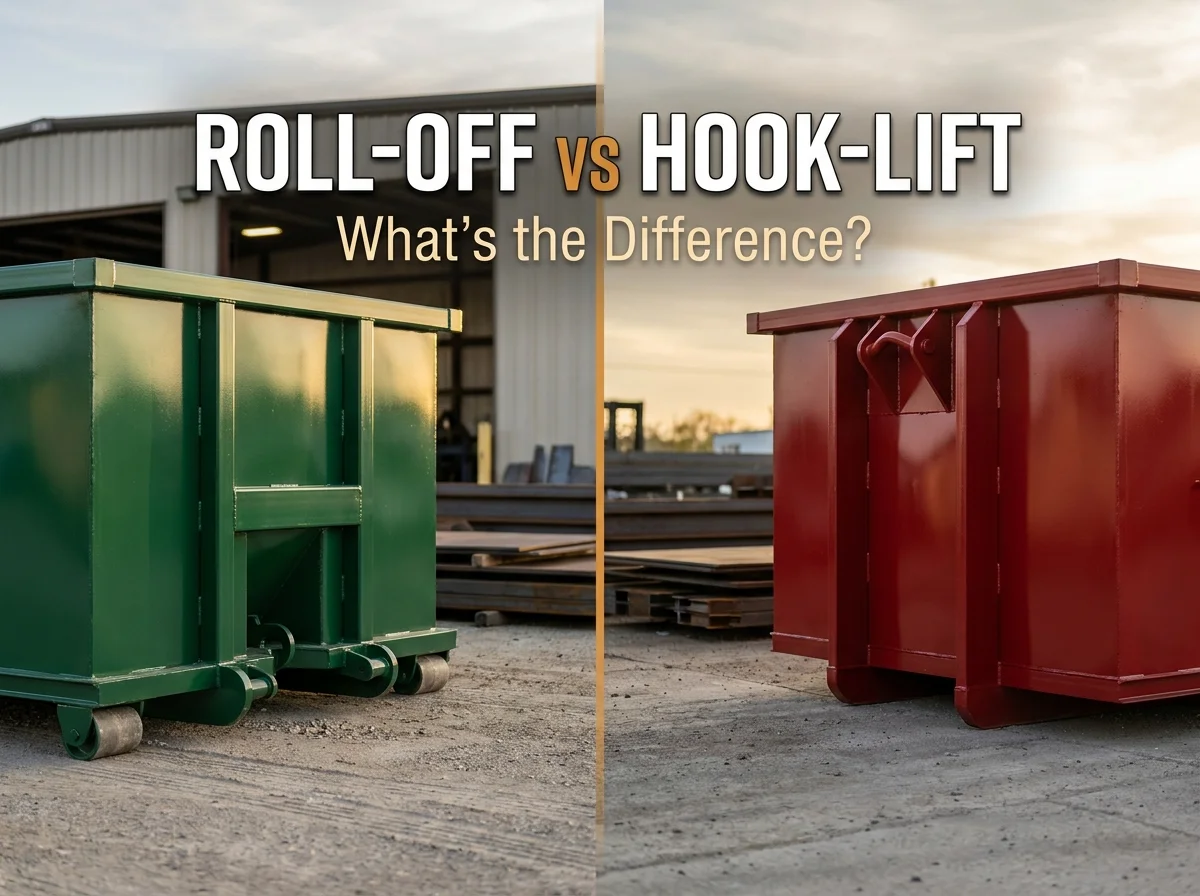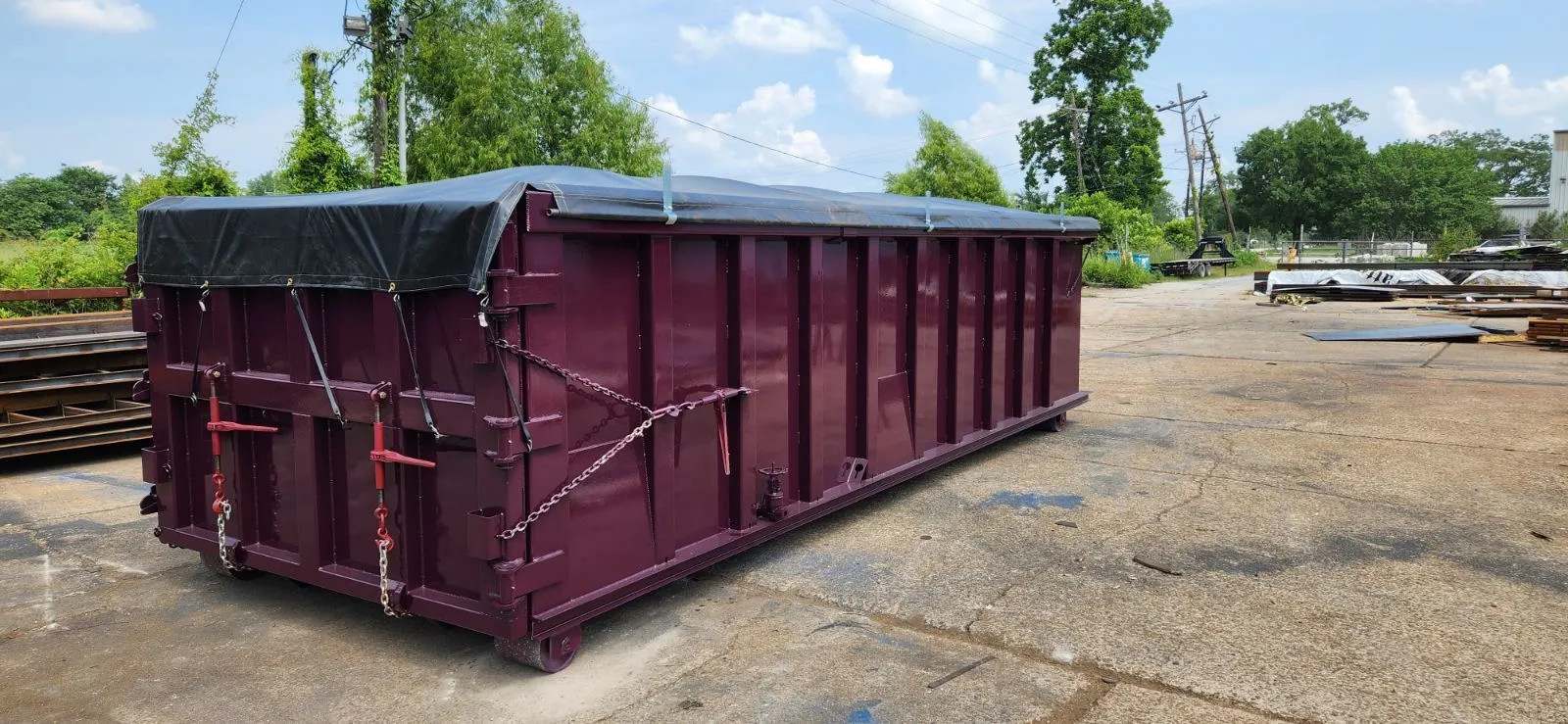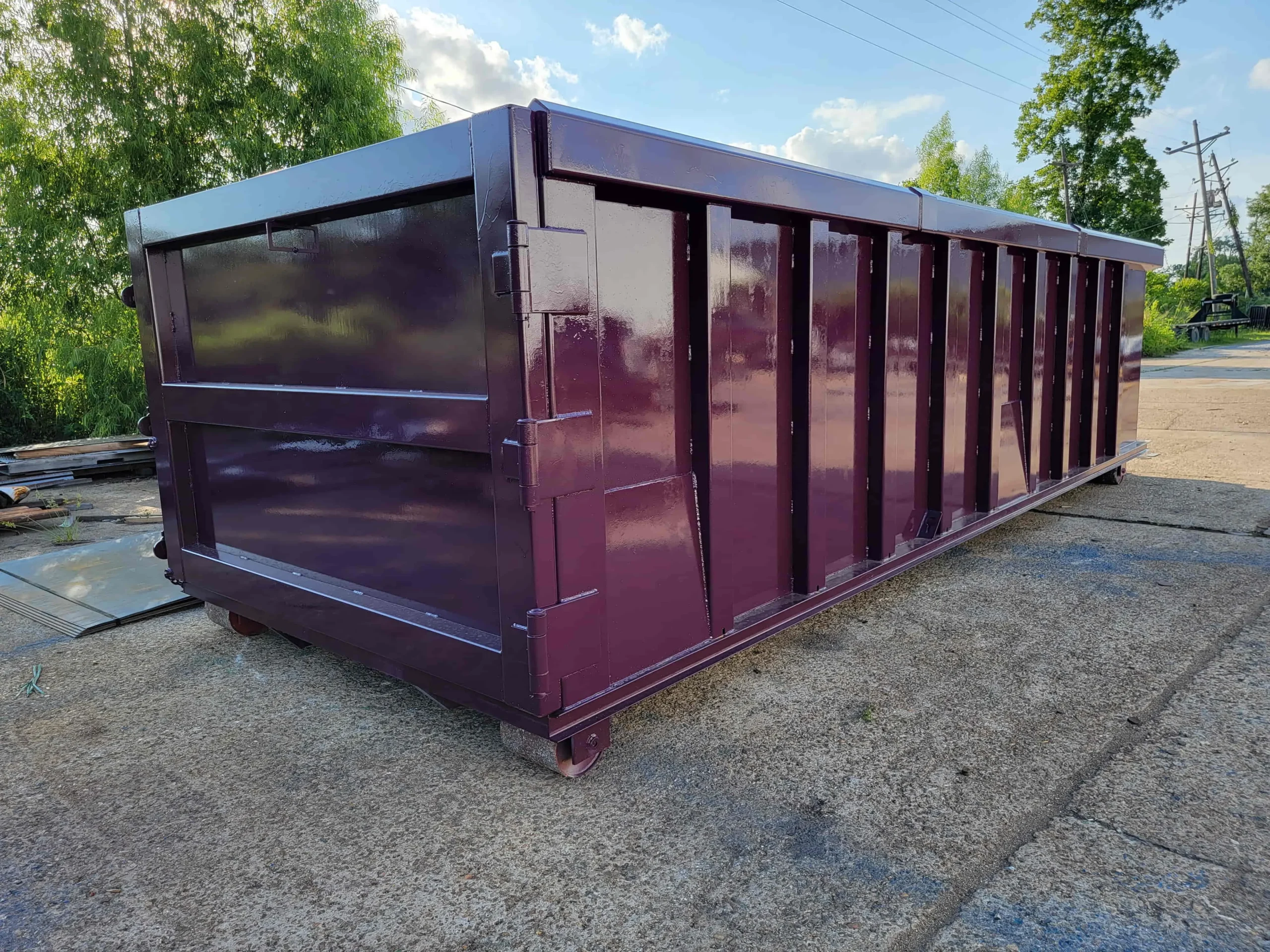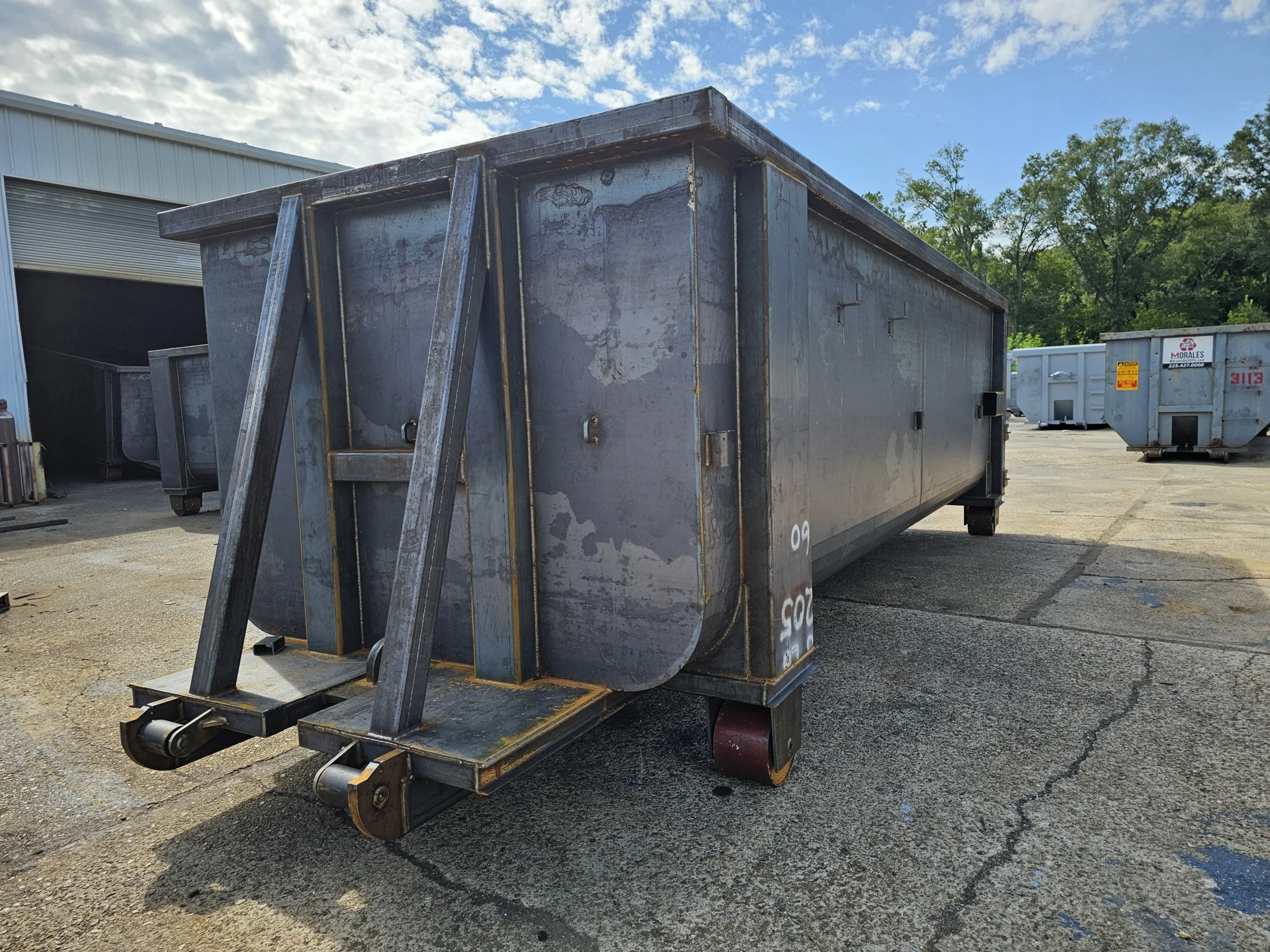
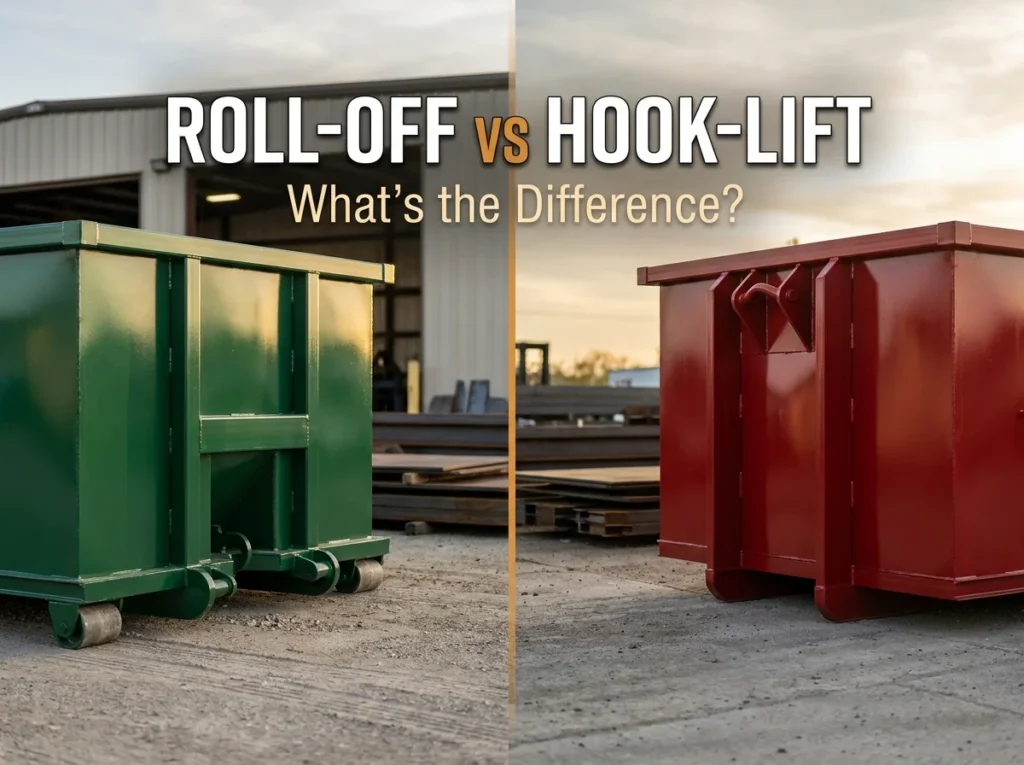
The main difference between roll-off and hook-lift containers is the system that loads them onto the truck. Roll-off containers use a steel cable and a winch that drags the container up tilted rails onto the truck bed, with rollers under the back end of the container doing the work. Hook-lift containers use a hydraulic L-shaped arm mounted on the truck that hooks onto a lifting bar at the front of the container and lifts it directly onto the truck. That single mechanical difference changes everything around it. Loading speed. Space required at the job site. Driver safety. Container price. Long-term operating cost. Resale value. After 25 years of building both kinds of containers in St. Gabriel, Louisiana for haulers across the Gulf Coast, Refuse Fab gets asked this question almost weekly by operators trying to decide which system to buy, and the honest answer is more nuanced than what most blogs tell you.
Here’s the manufacturer’s breakdown, with real numbers and the decisions you actually have to make.
The 60-Second Version
If you’re skimming, here’s the short version before we dig in.
Cable roll-off is the older, simpler, cheaper system. It dominates large-scale construction, demolition, and scrap industries where containers stay on a site for days or weeks at a time and space isn’t tight. Drivers exit the cab to attach the cable. Pickups take 5 to 8 minutes each.
Hook lift is the newer, faster, more flexible system. It dominates urban junk removal, mixed-use waste hauling, and any operation where the truck needs to drop and pick up containers quickly without leaving the cab. Pickups take 2 to 3 minutes each. The trade-off is higher initial cost and bigger overhead clearance needs.
Most hauling businesses run one or the other based on what their core work demands. Some run mixed fleets but it requires careful planning because the container designs are not interchangeable. We’ll explain why that matters in a minute.
How Cable Roll-Off Systems Actually Work
A cable roll-off truck has two main parts. A long steel rail bed that tilts backward and downward, and a winch with a steel cable mounted at the front of the bed.
When the truck arrives at a pickup, the driver gets out, walks to the front of the container, and attaches the steel cable to a hook welded to the front of the container body. The driver then operates the winch from a control panel on the truck, the bed tilts back at an angle, and the cable pulls the container up the rails. The container has small wheels or rollers welded under its back end. Those rollers ride up the rails and onto the bed of the truck. Once the container is fully on the bed, the truck levels out and the load is secured.
This system has been around since the 1950s. It’s mechanically simple, repairable in any small fab shop, and the trucks are relatively inexpensive to buy used. Most of the largest waste hauling fleets in the country built their business on cable roll-off.
The main downsides are the manual hookup, which puts the driver out of the cab and on the ground, and the tilting bed, which needs straight-line clearance behind the truck to operate. If a job site has a low overhang, a fence corner, or anything blocking that backward swing, cable roll-off becomes difficult or impossible.
How Hook Lift Systems Actually Work
A hook lift truck has a hydraulic articulated arm permanently mounted on the truck frame. The arm has a hook on the end. The container has a strong steel bar called a hook bar mounted on the front top corner, sized to match the truck arm.
When the truck arrives at a pickup, the driver stays in the cab, operates a joystick, and extends the hydraulic arm backward and downward until the hook engages the container’s hook bar. The arm then lifts the container up and forward onto the truck bed in one smooth motion. The container slides onto rails on the truck bed and locks into place. The driver never leaves the cab.
Hook lift was developed later than cable systems, and it solves the two biggest problems with cable roll-off. The driver stays in the cab, which improves safety and saves time on every pickup. And the system needs less straight-line clearance, which lets the truck work in alleys, parking decks, tight industrial yards, and any urban site where space is limited.
The trade-offs are real, though. The trucks cost significantly more than cable trucks. The hydraulic arm needs more overhead clearance during the lift cycle. And the containers themselves are built differently and cost more per unit because of the hook bar and reinforced front mounting.
Side-by-Side Comparison
Here’s the spec breakdown at a glance.
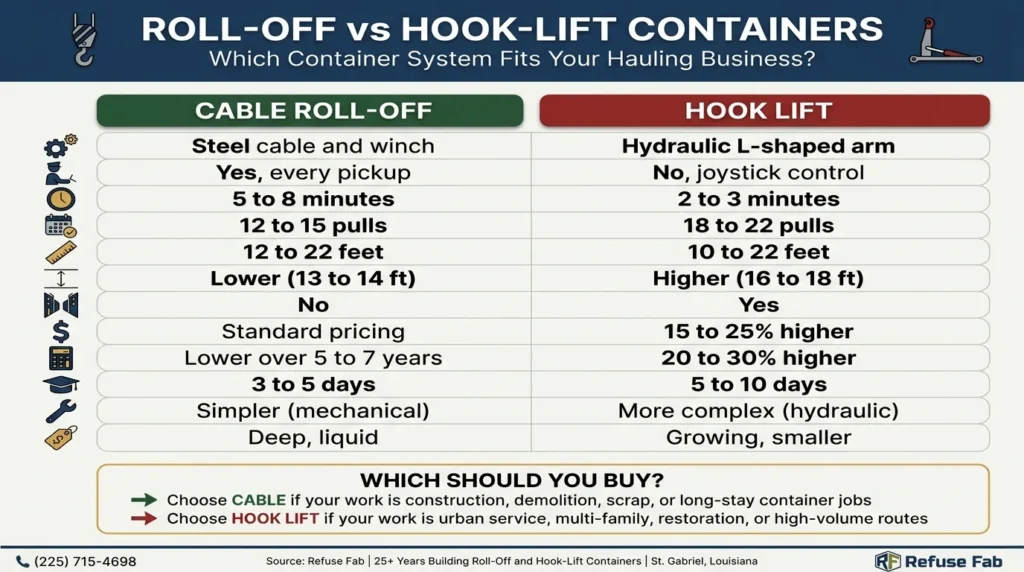
| Specification | Cable Roll-Off | Hook Lift |
|---|---|---|
| Lift mechanism | Steel cable and winch | Hydraulic L-shaped arm |
| Driver exits cab | Yes, every pickup | No |
| Average loading time | 5 to 8 minutes | 2 to 3 minutes |
| Container length range | 12 to 22 feet | 10 to 22 feet |
| Front attachment point | Bottom front hook | Top front hook bar |
| Overhead clearance during lift | Lower (about 13 to 14 feet) | Higher (about 16 to 18 feet) |
| Straight-line ground clearance behind truck | Required | Less critical |
| Best for tight urban sites | No | Yes |
| Best for open construction sites | Yes | Either works |
| Container retail cost (30-yard) | Lower baseline | 15 to 25 percent higher |
| Truck retail cost | Lower | Significantly higher |
| Driver training time | 3 to 5 days | 5 to 10 days |
| Maintenance complexity | Lower | Higher (hydraulics) |
| Resale value of containers | Strong, mature market | Growing but smaller market |
| Mixed-fleet compatibility | No, not interchangeable | No, not interchangeable |
A few of these deserve a closer look. The container length difference matters because hook lift systems can accommodate slightly shorter containers, which is useful for tight job sites. The container cost difference matters because if you’re buying 20 containers, a 20 percent price difference adds up fast. And the maintenance complexity matters because hydraulic systems need more skilled repair work than a simple winch and cable.
The Real Cost Difference
Most articles claim hook lift costs about 5 percent more than cable. That’s misleading because it doesn’t tell you where the cost shows up.
The container itself is where the manufacturer pricing splits. A 30-yard cable roll-off container with standard build specs typically runs in a range we won’t quote publicly here, but the same 30-yard container built for hook lift use, with the reinforced hook bar and front mounting plate, runs roughly 15 to 25 percent higher per unit. Over a 50-container fleet, that difference is significant.
The truck side is where the much bigger cost lives. A new cable roll-off truck and a new hook lift truck can differ by tens of thousands of dollars, with hook lift trucks being more expensive because of the hydraulic system. Used markets exist for both but used hook lift trucks command a premium.
The third cost layer is operations. Hook lift trucks complete more pickups per shift because of the speed advantage. A typical cable driver might do 12 to 15 pulls in an 8-hour day. A hook lift driver in similar conditions might do 18 to 22 pulls. That productivity difference pays back the higher equipment cost over time, especially for high-volume urban routes.
The fourth cost layer is maintenance. Cable systems wear in predictable places. The cable itself needs periodic replacement. The winch needs servicing. The container rollers and rails wear with use. All of this is straightforward shop work. Hook lift hydraulics need more skilled maintenance, and a hydraulic leak or pump failure is a more expensive repair than a snapped cable.
When you total all four cost layers over a 5 to 7 year operating window, hook lift typically costs 20 to 30 percent more in total ownership for an equivalent operating volume. That’s the real number, not 5 percent.
Which System Fits Which Job Site
This is the part most blogs skip. Here’s the decision matrix based on what we see across our customer base, including operators like Morales Rolloffs, Geaux Throw Waste Management, Louisiana Scrap Metal, and others running fleets across the Gulf Coast.
| Job Site Type | Better System | Why |
|---|---|---|
| Large open construction site | Cable | Container stays for days, cost matters more than speed |
| Demolition jobs | Cable | Heavy debris loads, simple equipment, plenty of room |
| Scrap metal yards | Cable or mixed | Heavy loads, in-yard movement, fixed sites |
| High-volume urban junk removal | Hook lift | Speed wins, tight spaces, multiple pickups per day |
| Multi-family property cleanouts | Hook lift | Apartment complex parking lots, tight maneuvering |
| Industrial recycling routes | Hook lift | Multiple drops per shift, plant access road sizes |
| Roofing contractor work | Cable | Long stays, big loads, residential streets are wide enough |
| Restoration and remediation | Hook lift | Quick pickups, often urban or campus environments |
| One-off residential cleanouts | Either | Volume too low to optimize around system |
The pattern is simple. Cable wins when containers sit on site for a long time and the job has room. Hook lift wins when speed and access matter more than per-container cost.
If you’re starting a new hauling business and your core work is going to be one of those categories, pick the system that fits 80 percent of your jobs. Don’t try to optimize for the 20 percent edge cases.
Can I Switch From Cable to Hook Lift?
Short answer: yes, but it’s not cheap.
The containers themselves are not interchangeable. A cable roll-off container does not fit a hook lift truck without retrofit work, and that retrofit means welding on a hook bar, reinforcing the front mounting plate, and sometimes modifying the container’s structural geometry. Cost per container to retrofit runs in the same ballpark as roughly 30 to 50 percent of the cost of a new container, depending on condition. That’s not always worth it.
Most haulers who switch systems do so by selling their existing cable fleet on the used market, where there’s strong demand from smaller startup operators, and buying new hook lift trucks and containers. The transition takes 12 to 24 months for most fleets to fully complete.
A few haulers we work with run mixed fleets intentionally. They keep cable trucks and containers for big construction and demolition jobs and run hook lift trucks for urban and multi-family routes. This works but requires careful logistics so the right container goes to the right job. You can’t send a cable hauler to a hook lift container or the other way around.
Driver Training and Daily Operations
Cable system training is shorter because the operation is mechanically simpler. A new driver can typically be cleared for solo cable roll-off work in 3 to 5 days of supervised practice. The skills are physical: hooking the cable safely, operating the winch, and securing loads.
Hook lift training is longer because the joystick controls require more practice to develop fine motor coordination. Most haulers we work with figure 5 to 10 days of supervised practice before a new driver is comfortable solo. The trade-off is that once trained, hook lift drivers report less physical fatigue at the end of a shift because they’re not climbing in and out of the cab 15 times a day.
For older drivers or anyone with shoulder, back, or knee issues, hook lift is significantly easier on the body. That’s a recruitment and retention angle most managers don’t think about until they’re losing experienced drivers to physical wear.
What We Recommend at Refuse Fab
The honest manufacturer answer is that the right system depends entirely on what your business does. We’ve built both systems for 25 years and we’ve seen successful operations on both sides. The wrong move is to chase the system someone else is using without thinking through whether it fits your work.
If your core business is construction, demolition, or scrap, cable is almost always the right move. Lower entry cost, simpler trucks, easier maintenance, deeper used parts market.
If your core business is urban service work, multi-family, restoration, or high-frequency pickups, hook lift earns its higher cost back through speed and access.
If you’re growing into both and have the capital, a mixed fleet works but requires planning. Don’t try to mix the containers themselves. Plan your fleet as two operations that share dispatching and overhead.
And if you’re not sure, ask other operators in your specific niche what they run. Not waste hauling generally, but your specific work type. The right answer for a demolition contractor in Baton Rouge is different from the right answer for an urban junk hauler in New Orleans.