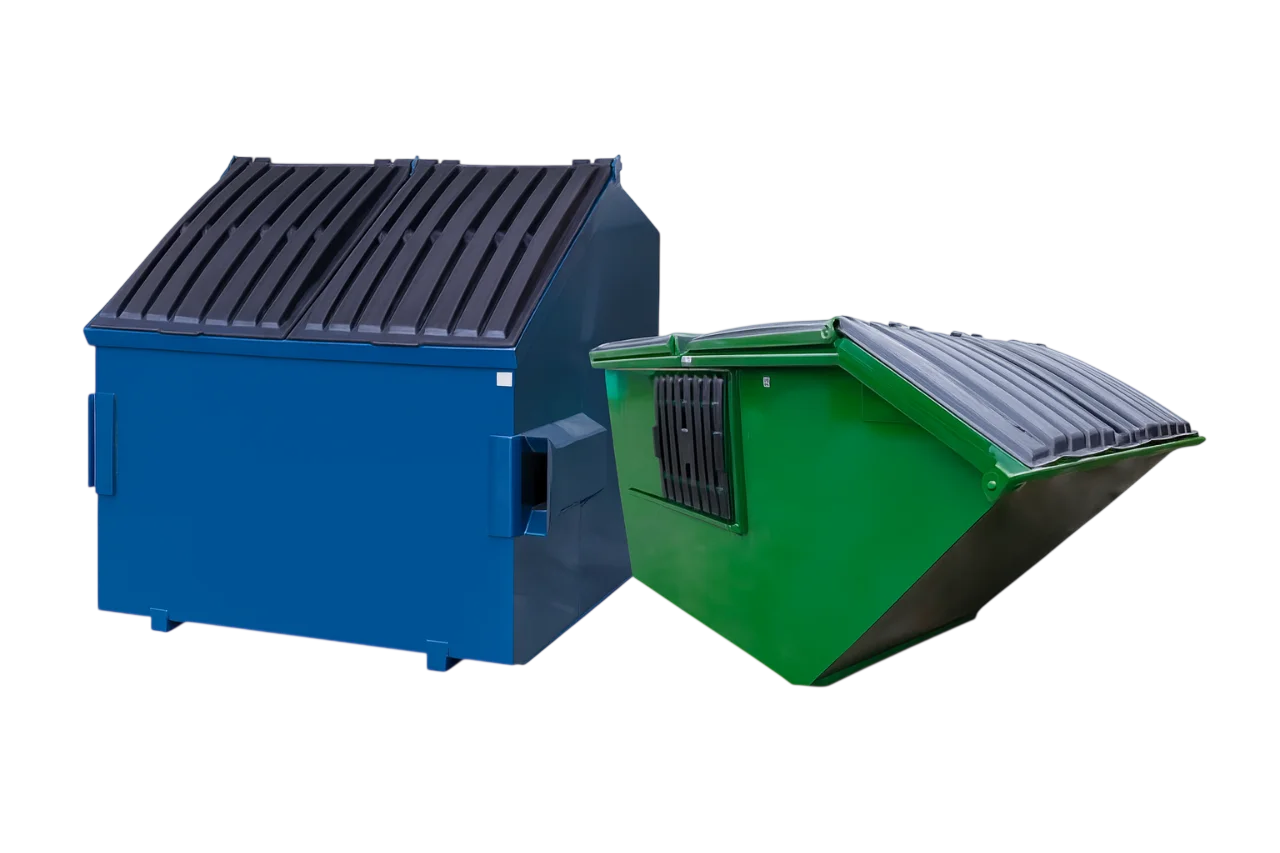
Front-load and rear-load dumpsters are both commercial waste containers, but they are built differently, emptied by different trucks, and suited to different job sites. What separates them comes down to how the truck picks them up. Front-load containers have fork pockets on the sides that a front-loader truck grabs with hydraulic arms and tips overhead. Rear-load containers have trunnion bars on the back that hook into a rear-loader truck’s winch system and get pulled up and over.
That one mechanical difference changes everything about how each container is engineered, where it can be placed, and which operation it works best for.
How Front-Load Containers Are Built
Front-load containers (also called front end load or FEL units) are the boxes you see behind most strip malls, restaurants, and apartment complexes. Each one sits on a concrete pad, and a front-loader truck drives up, slides its hydraulic forks into the pockets on the container’s sides, lifts the entire unit overhead, and dumps the contents into the truck’s hopper.
That lifting motion puts enormous stress on the fork pockets. Picture a loaded 8-yard front-load container weighing well over 2,000 pounds, and all of that weight hanging from two pocket openings while the container tilts upside down. It is why the fork pocket area is the most heavily reinforced part of the container.
On a well built front-load unit, the fork pockets use three-way flared openings to guide the truck’s forks in cleanly and prevent impact damage. Underneath the pockets, gussets (often called taco gussets because of their curved shape) are welded to the bottom to absorb the lifting stress. No-step gussets run across the top of the pocket area for additional support. All of this welding is continuous, not stitch welded, because a stitch weld in a high-stress zone will crack over time.
Standard Construction Specs
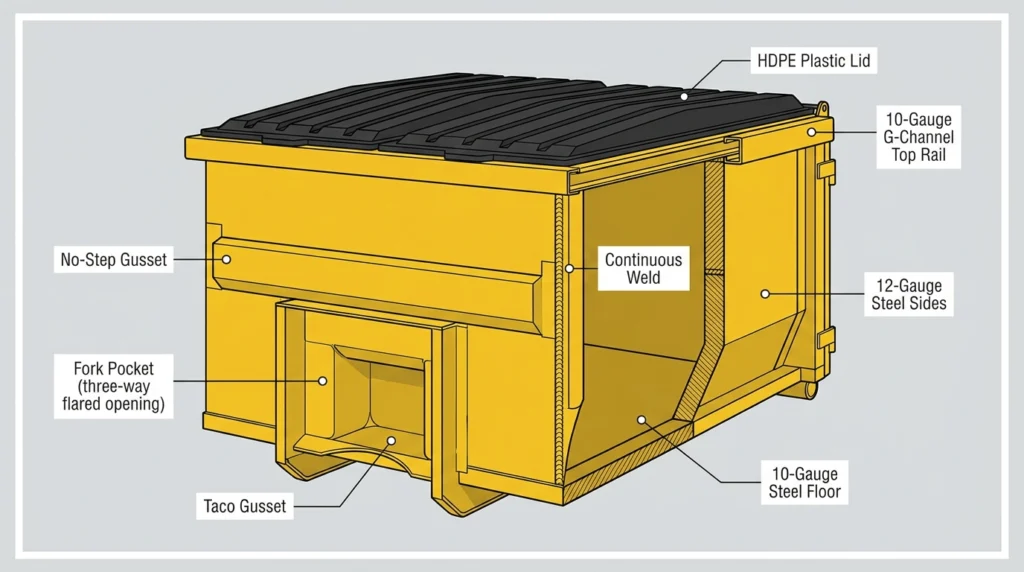
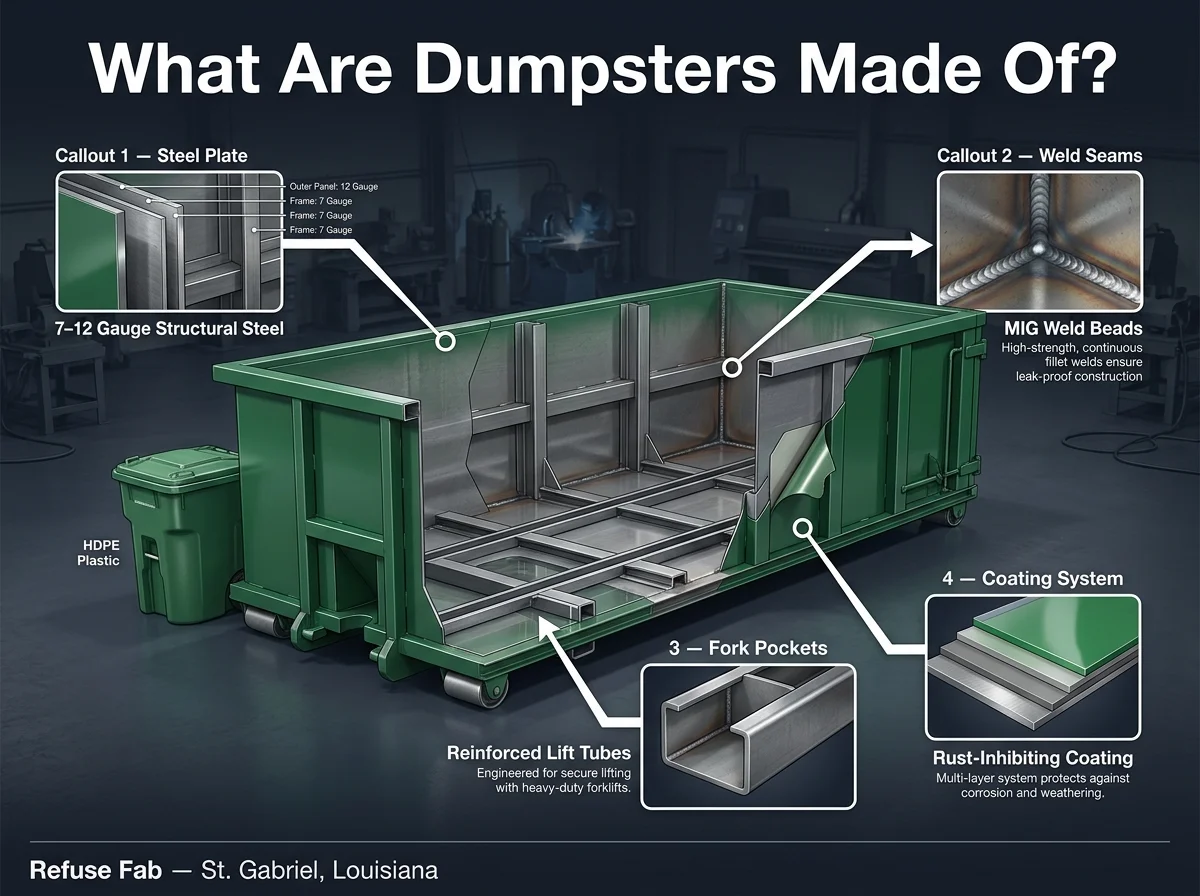
Most manufacturers build front-load containers with 12-gauge steel on the sides and 10-gauge steel on the floors. Heavy duty versions step up to 10-gauge sides and 7-gauge floors. Up top, the rail is typically a formed 10-gauge G-channel that interlocks around the perimeter and gives the container its rigidity.
Lids on front-load containers are almost always high-density polyethylene (HDPE) plastic. Steel lids add too much weight to a container that already gets lifted overhead multiple times a week. Plastic lids sit on steel frames and swing open when the container tips.
Front-Load Sizes and Weights
| Size | Typical Dimensions (W x D x H) | Empty Weight |
|---|---|---|
| 2 Yard | 72″ x 38″ x 41″ | ~500 lbs |
| 3 Yard | 72″ x 42″ x 48″ | ~600 lbs |
| 4 Yard | 72″ x 56″ x 50″ | ~730 lbs |
| 6 Yard | 72″ x 68″ x 64″ | ~970 lbs |
| 8 Yard | 72″ x 82″ x 73″ | ~1,110 lbs |
Width stays at 72 inches across all sizes because it needs to match the fork spacing on the truck. Depth and height increase as the container gets larger.
Clearance Requirements
Most people forget to check this until the truck shows up. Front-load trucks need roughly 18.5 feet of overhead clearance when the container is in the raised position. Each truck stands about 12.5 feet tall and 8 feet wide. With the boom arms extended, total approach length runs about 41 feet. And the turning radius on these trucks is around 46 feet, which means the truck needs close to a 97-foot turning diameter if it has to swing around on site.
If you are placing front-load containers at a property, measure overhead clearance first. Trees, awnings, power lines, and parking garage overhangs are the most common problems. Containers that sit fine on the pad but can’t actually be serviced because the truck doesn’t have room overhead are an expensive mistake.
How Rear-Load Containers Are Built
Rear-load containers (also called rear end load or REL units) look different from a front-load right away. Instead of fork pockets on the sides, each one has a solid steel trunnion bar welded to the back. This bar hooks into the truck’s rear-mounted arms, and a winch system pulls the container up and over the back of the truck to dump the contents.
Engineering priorities shift with the rear-load design. On a front-load container, stress concentrates at the fork pockets. On a rear-load container, it concentrates at the back bar and the pivot point where the container tips. Back channels get reinforced with solid 1-inch steel, and on larger models (6 to 8 yard), two reinforcing channels run across the back for added strength.
Smaller rear-load containers (1 to 3 yards) are typically built from 14-gauge steel with a single-piece body wrap. This means the sides and bottom are formed from one continuous sheet with no seams along the corners. Larger 4 to 8 yard models step up to 12-gauge steel and use continuous welded seams around the corners instead.
Trunnion Bar Sizing
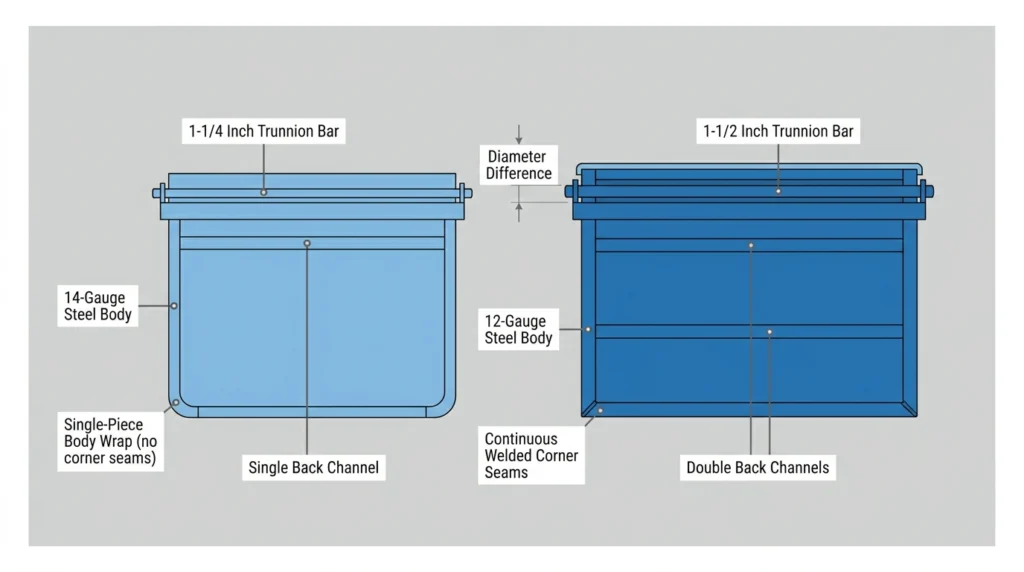
Trunnion bar diameter changes with container size:
| Container Size | Trunnion Bar Diameter |
|---|---|
| 1 to 2 Yard | 1-1/4 inch solid steel |
| 3 Yard | 1-3/8 inch solid steel |
| 4 to 8 Yard | 1-1/2 inch solid steel |
These bars need to match the truck’s lifting mechanism. If the bar diameter is wrong for the truck, the container won’t seat properly and the truck can’t lift it safely. This is one of the details that matters when ordering containers for a specific fleet.
Rear-Load Sizes and Weights
| Size | Typical Dimensions (L x W x H) | Empty Weight |
|---|---|---|
| 1 Yard | 27″ x 65″ x 45″ | ~300 lbs |
| 1.5 Yard | 37″ x 65″ x 45″ | ~320 lbs |
| 2 Yard | 43″ x 65″ x 49″ | ~370 lbs |
| 3 Yard | 80″ x 67″ x 45″ | ~500 lbs |
| 4 Yard | 80″ x 67″ x 50″ | ~670 lbs |
| 6 Yard | 122″ x 68″ x 50″ | ~970 lbs |
| 8 Yard | 144″ x 68″ x 50″ | ~1,250 lbs |
Notice the size range. Rear-load containers start at 1 yard, while front-load containers typically start at 2 yards. This makes rear-load the better option for smaller businesses that don’t generate enough waste to justify a 2-yard minimum.
Also notice that the 8-yard rear-load container weighs about 140 pounds more than the 8-yard front-load. That is because rear-load containers at larger sizes use heavier back channels and reinforcement to handle the winch-and-tip stress. Front-load designs distribute weight differently through the fork pocket gusset system.
Clearance and Access
Rear-load trucks need less overhead clearance than front-load trucks because the container tips from the back of the truck rather than going straight up over the cab. But the truck needs clear access at the rear of the container. Drivers back up to the unit, hook the trunnion bar, and lift from behind. Narrow alleys and tight spaces work better with rear-load containers for this reason, as long as the truck can get close to the back of the unit.
Side-by-Side Comparison
| Feature | Front-Load | Rear-Load |
|---|---|---|
| How it’s emptied | Hydraulic forks lift from sides, tip overhead | Winch hooks trunnion bar, pulls up and over rear |
| Size range | 2 to 8 cubic yards (some manufacturers offer 10) | 1 to 8 cubic yards |
| Standard steel gauge (sides) | 12 gauge | 14 gauge (1-3 yd), 12 gauge (4-8 yd) |
| Standard steel gauge (floor) | 10 gauge | Same as sides on most models |
| Overhead clearance needed | ~18.5 feet | Less (tips from rear of truck) |
| Best for tight spaces | No (needs clearance above and in front) | Yes (narrower profile, lower height) |
| Casters standard | No (sits on pad) | Yes on 1-3 yard models |
| Truck compatibility | Front-loader trucks with hydraulic forks | Rear-loader trucks with winch arms |
| Lid material | HDPE plastic (lighter for overhead lifting) | HDPE plastic on steel frames |
| Purchase cost (new, per unit) | $1,200 to $3,500 depending on size | $1,100 to $3,000 depending on size |
Which One Fits Your Operation
It comes down to three things: your truck fleet, your site conditions, and your waste volume.
Truck fleet compatibility comes first. Front-load containers only work with front-loader trucks, and the fork pocket spacing on the container must match the fork spacing on your trucks. Buying from a new manufacturer? Confirm this measurement before you order.
Tight urban routes favor rear-load containers. The lower profile, narrower footprint, and reduced overhead clearance requirements make them workable in alleys and behind buildings where a front-loader truck simply cannot operate.
Small business accounts generating 1 to 2 yards of waste per week leave you with one option: rear-load. Front-load containers don’t go below 2 yards.
Open commercial sites like strip malls, apartment complexes, and properties with dedicated pad areas are where front-load containers earn their keep. Service is faster because the truck pulls up and dumps without needing to back in, and front-loader trucks can carry more stops per route because the dumping cycle is quicker.
For waste haulers building or expanding a fleet of commercial containers, most operations end up running a mix. Each route determines the container. Urban routes lean rear-load. Suburban commercial routes lean front-load.
What About Roll-Off Containers?
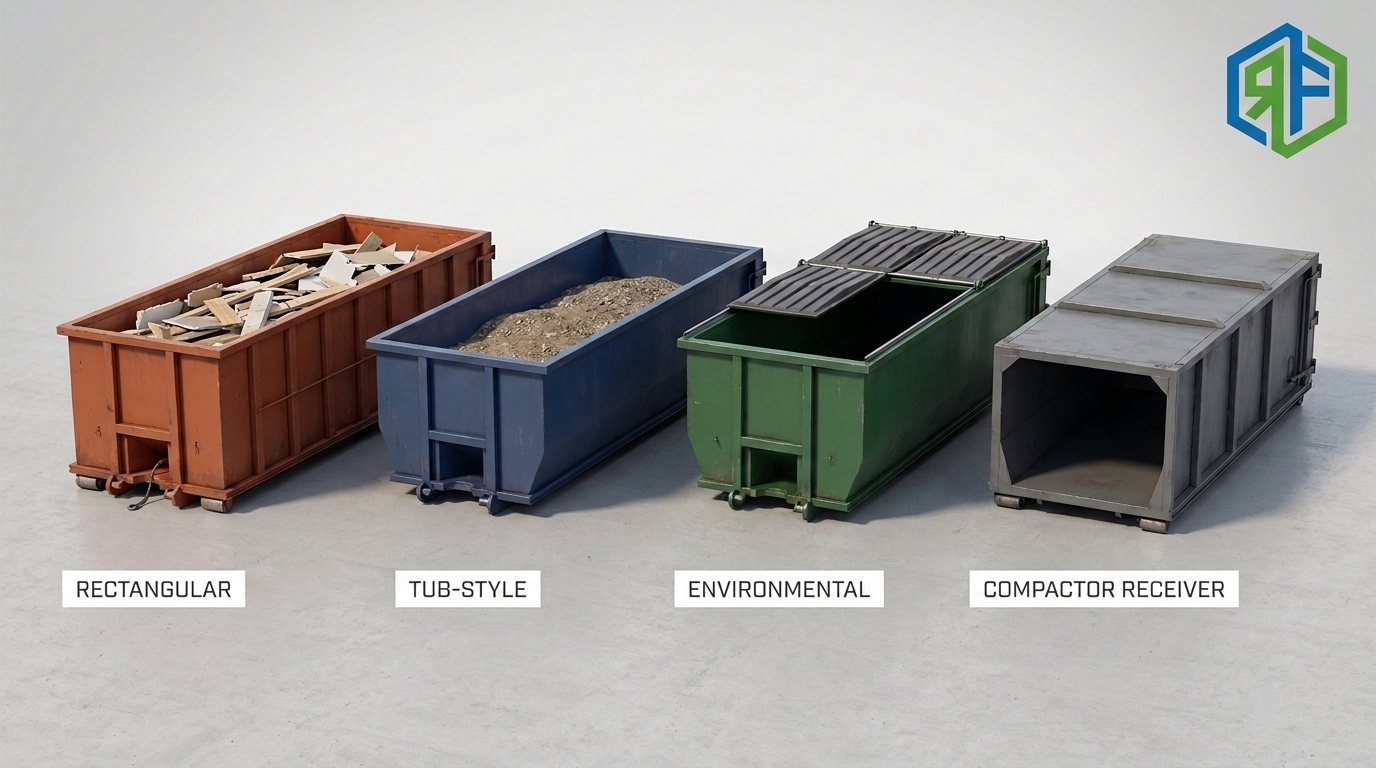
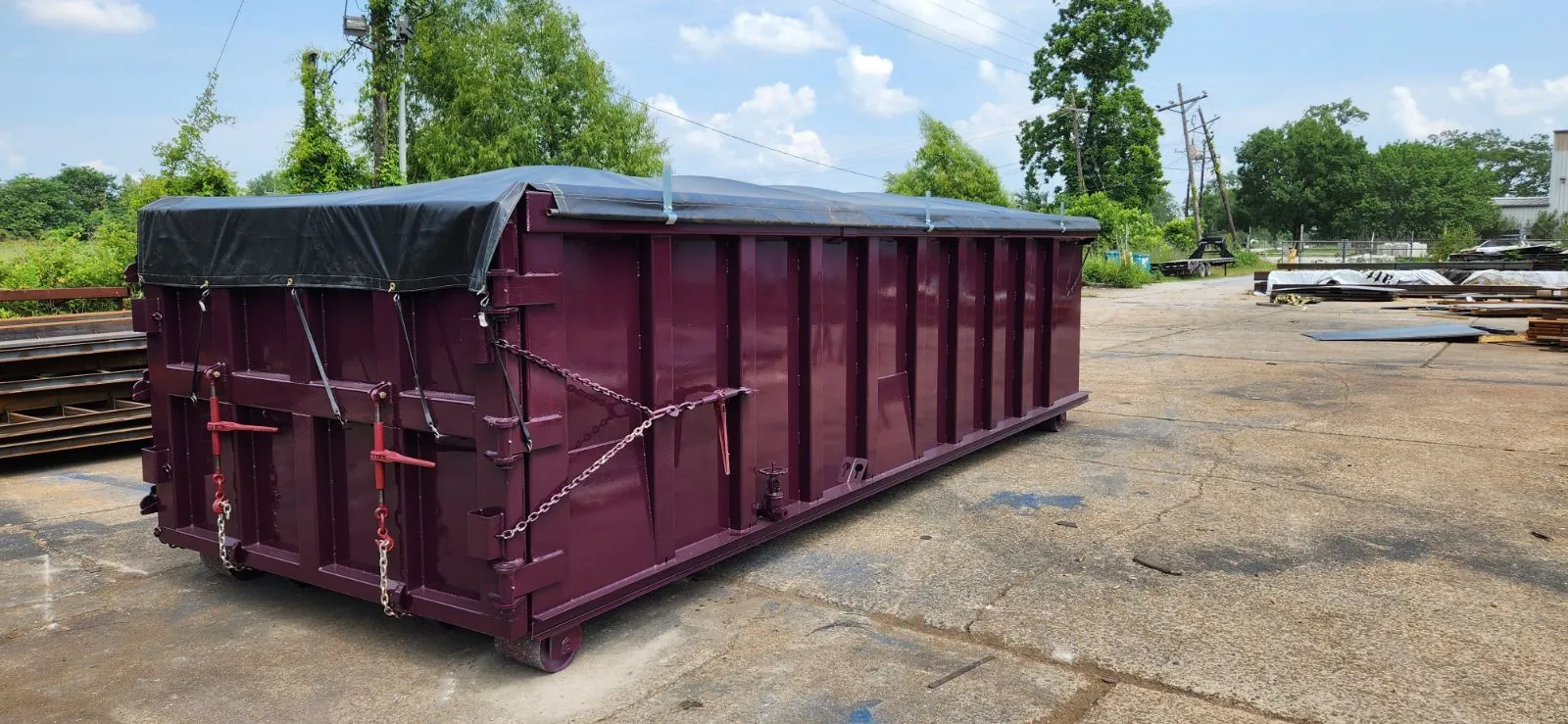
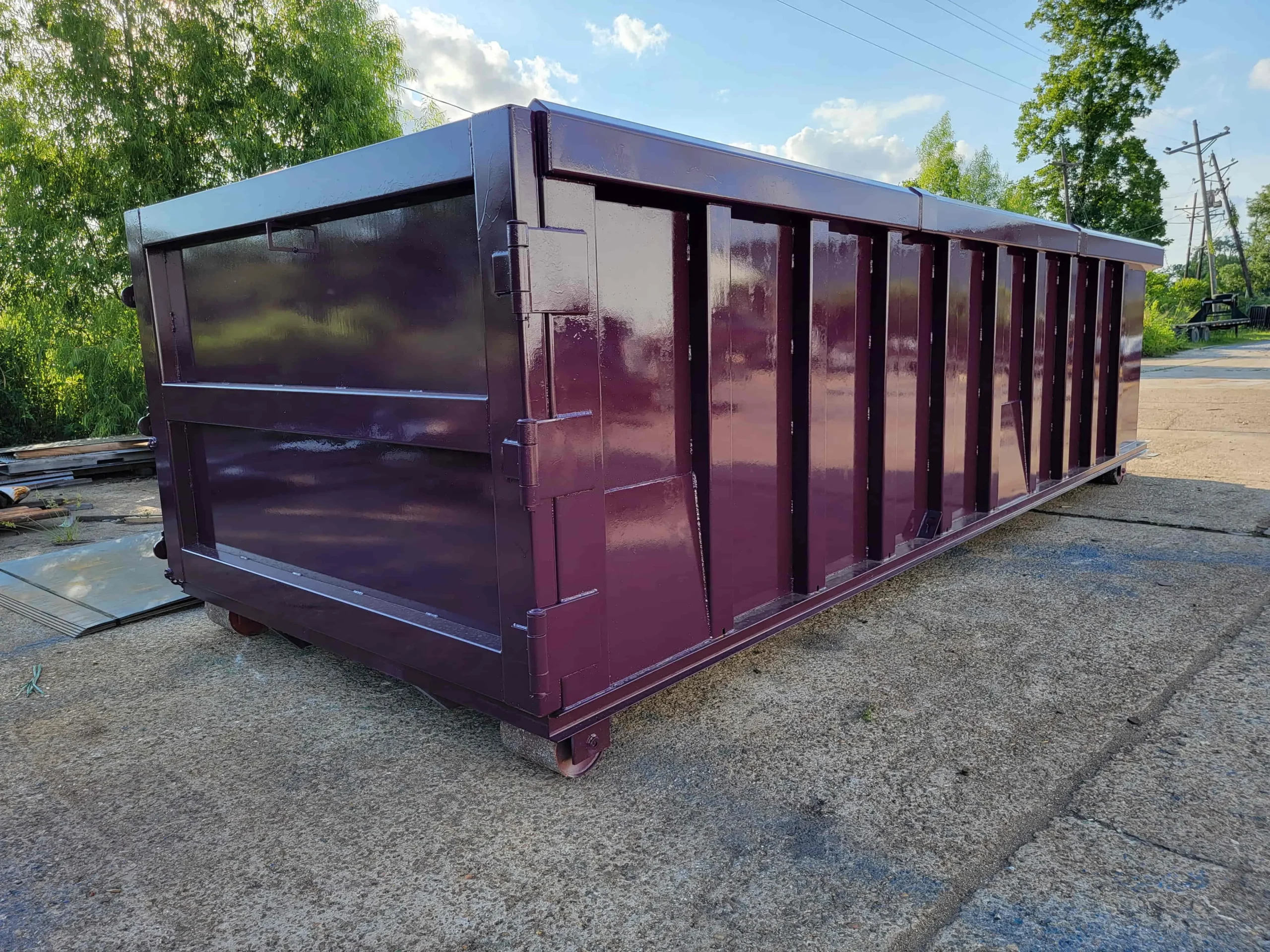
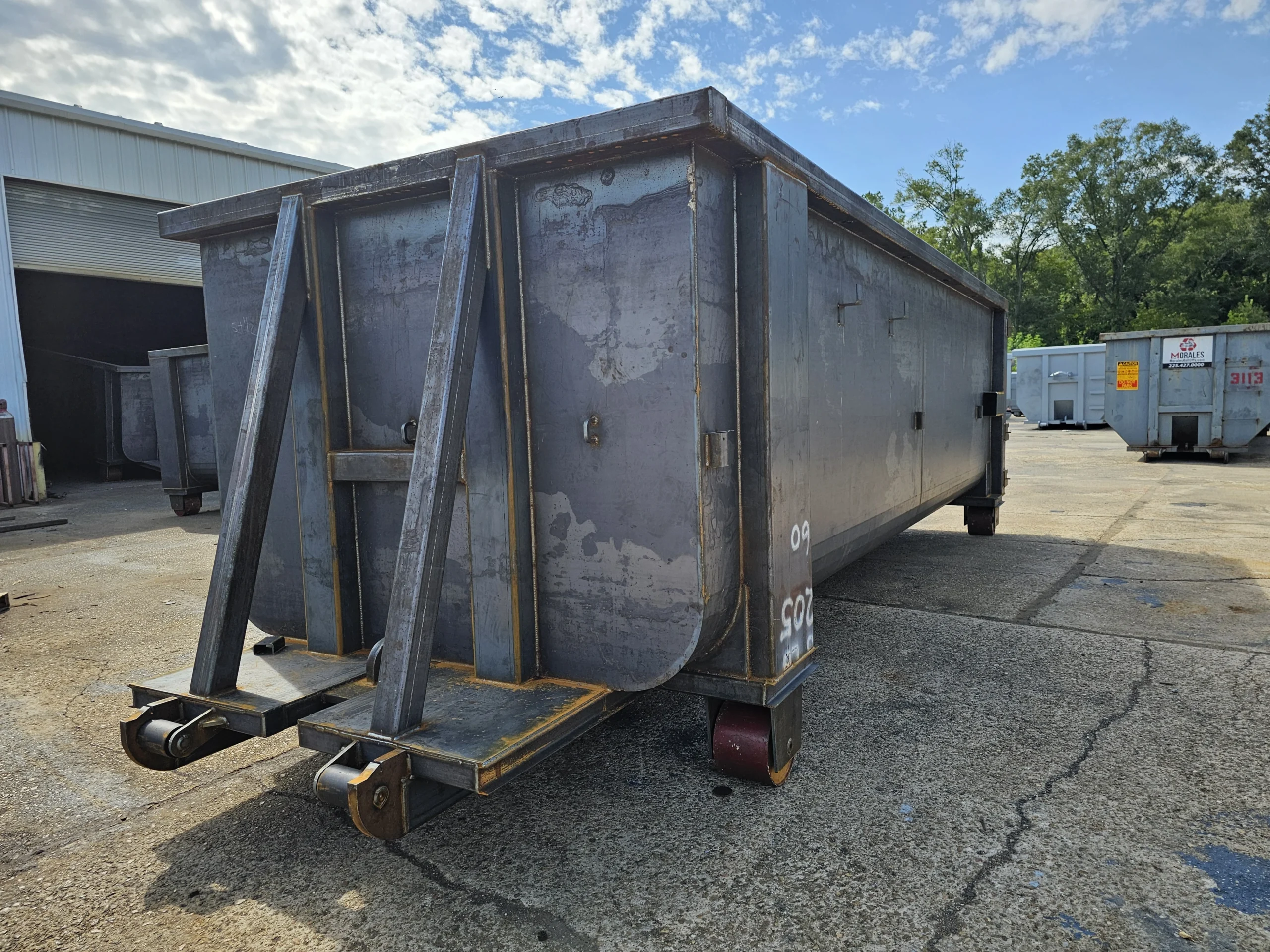
Front-load and rear-load containers are both commercial waste containers designed for scheduled pickup service. They stay on site and get emptied regularly. Roll-off containers are a completely different category. Roll-offs are temporary or semi-permanent containers that get hauled away entirely when full and replaced with an empty unit. They run from 10 to 40 cubic yards and are used on construction sites, demolition jobs, and large cleanout projects. If you need that type of container, our rectangle and tub-style roll-off pages cover what we build.
Frequently Asked Questions
What is the most common front-load dumpster size? In commercial service, 6-yard and 8-yard front-load containers are the most widely used. Six-yard units work well for mid-size restaurants, retail stores, and small office buildings. Eight-yard units handle higher volume accounts like grocery stores, large apartment complexes, and shopping centers.
Can a front-load truck pick up a rear-load container? No. These two systems are not interchangeable. Front-load trucks use hydraulic forks that slide into pockets on the container’s sides. Rear-load trucks use a winch and arm system that hooks a trunnion bar on the container’s back. Ordering the wrong container type for your truck fleet means the container cannot be serviced.
How long do front-load and rear-load containers last? With proper maintenance, a well built steel container lasts 10 to 15 years in regular commercial service. Lifespan depends on waste type (corrosive materials shorten it), pickup frequency, and whether the container gets dragged across pavement regularly. Heavier gauge steel and continuous welds add years over lighter builds with stitch welds.
Are rear-load containers cheaper than front-load? In most cases, yes, by a small margin. Rear-load containers in the 1 to 3 yard range use thinner steel (14 gauge vs 12 gauge) and weigh less, so material cost is lower. At larger sizes (6 to 8 yards), the cost difference narrows because both types use similar gauge steel and the rear-load version actually weighs more due to its heavier back channel reinforcement.
What size trunnion bar do I need for my rear-load truck? This depends on your truck manufacturer and model. Standard trunnion bar diameters are 1-1/4 inch for 1 to 2 yard containers, 1-3/8 inch for 3 yard, and 1-1/2 inch for 4 to 8 yard containers. Confirm the bar diameter with your truck manufacturer before ordering containers to make sure they seat correctly in the lifting mechanism.
Do front-load dumpsters come with wheels? Standard front-load containers do not have casters. They sit stationary on a concrete pad. Some manufacturers offer optional caster kits for smaller front-load sizes (2 to 4 yards), but the larger units (6 to 8 yards) are too heavy to move on wheels when loaded. Rear-load containers in the 1 to 3 yard range come with casters as standard because they are often positioned by hand in tight spaces.
How much overhead clearance does a front-load truck need? About 18.5 feet when the container is fully raised. Each truck stands roughly 12.5 feet tall. Before placing a front-load container, check for trees, awnings, power lines, building overhangs, and parking structure clearances. If the truck cannot raise the container safely, the site needs a rear-load container instead.
Can I get a custom front-load or rear-load container? Yes. Custom fabrication is standard in this industry. Containers can be built in specific colors for fleet branding, fitted with lockable lids, reinforced with heavier gauge steel for harsh waste streams, or built to non-standard dimensions for unusual site requirements. If you need something outside the standard catalog, contact our team with your specifications.
Last updated: October 2026