Roll-off dumpsters can handle a lot — construction debris, old furniture, roofing tear-offs, general household junk. But they can’t take everything. Toss the wrong item into a roll-off container and you could be looking at extra fees, a rejected load, or in serious cases, actual fines.
The tricky part? The rules aren’t the same everywhere. What’s banned in one county might be accepted (with a surcharge) in the next one over. Some restrictions come from federal law, others from state regulations, and plenty are set by the hauler or landfill themselves.
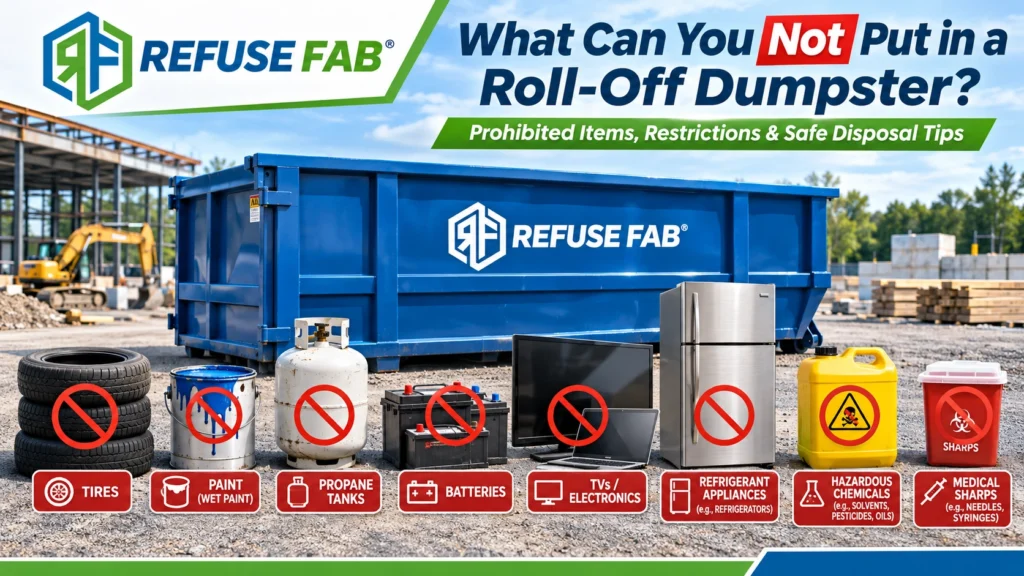
The short answer? Hazardous chemicals, batteries, tires, propane tanks, refrigerant appliances, electronics, medical waste, asbestos, flammable liquids, and wet paint are banned from roll-off dumpsters pretty much everywhere. Items like concrete, mattresses, and yard waste fall into a gray area depending on your location.
This guide breaks down what’s universally prohibited, what depends on your location, and what’s always fair game — plus what actually happens if something banned ends up in your container.
Why Certain Items Are Banned from Dumpsters
It’s not arbitrary. Prohibited items typically fall into one of four categories:
They’re hazardous. Chemicals, batteries, and fuels can leak, react, or combust — contaminating the landfill, injuring workers, or polluting groundwater. The EPA regulates these under the Resource Conservation and Recovery Act (RCRA), and violations carry real penalties.
They damage equipment. Certain materials can wreck compactors, puncture container floors, or gum up sorting lines. Adhesives and resins, for example, bond debris together and make the container nearly impossible to empty cleanly.
They’re an environmental hazard. Tires trap methane gas, destabilize landfill surfaces, and breed mosquitoes. Refrigerants destroy ozone. Mercury from fluorescent bulbs and electronics leaches into soil. These items need controlled handling, not a landfill trench.
They’re too heavy. Concrete, dirt, and brick aren’t banned everywhere, but they can push a container past weight limits fast — and an overweight load creates DOT problems, road damage, and safety risks during transport.
Items You Can Never Put in a Roll-Off Dumpster
These are universally prohibited. No hauler, no landfill, no exceptions.
| Category | Specific Items | Why They’re Banned |
|---|---|---|
| Hazardous chemicals | Pesticides, herbicides, solvents, thinners, acids, caustic cleaners | Contaminate soil and groundwater; toxic to workers |
| Paints and stains | Wet paint, lacquers, wood stains, varnishes, pre-1990s paint (lead risk) | Leak through containers; potential lead content |
| Flammable liquids | Gasoline, diesel, kerosene, lighter fluid, motor oil, transmission fluid | Fire and explosion risk during transport and at the landfill |
| Batteries (lithium-ion) | Phone, laptop, tablet, power tool, e-bike, and scooter batteries | Thermal runaway risk — can ignite or explode when crushed |
| Batteries (lead-acid) | Car, truck, boat, and motorcycle batteries | Contain sulfuric acid and lead; corrosive and toxic |
| Tires | Any size — car, truck, equipment, ATV | Trap methane, destabilize landfills, breed mosquitoes, burn for months |
| Propane and compressed gas | Propane tanks, oxygen tanks, acetylene cylinders, aerosols with pressure | Explosion risk under compaction or heat |
| Refrigerant appliances | Refrigerators, freezers, AC units, dehumidifiers | Contain Freon/CFCs/HFCs — federal law requires certified refrigerant removal |
| Hot water tanks | Gas and electric water heaters | Can contain residual gas; explosion risk during compaction |
| Medical waste | Needles, syringes, sharps, blood-soaked bandages, expired medications | Biohazard — needlestick injuries can transmit bloodborne pathogens |
| Asbestos | Insulation, floor tiles, siding, pipe wrap from older buildings | Airborne fibers cause mesothelioma; requires licensed abatement |
| Electronics (e-waste) | TVs, monitors, computers, laptops, phones, printers, gaming consoles | Contain lead, mercury, cadmium; many states ban e-waste from landfills |
| Railroad ties and treated wood | Creosote-treated lumber, telephone poles | Wood preservatives are toxic; leach into soil and groundwater |
| Adhesives and resins | Industrial glue, epoxy, roofing tar (in liquid form) | Bond debris together; damage container interiors; difficult to process |
| Ink and industrial fluids | Printer ink in bulk, industrial solvents, hydraulic fluid | Toxic; stain and damage containers permanently |
Hazardous Chemicals and Solvents
This category catches more people than any other. If it came from under the sink, the garage shelf, or a job site chemical locker, it probably doesn’t belong in a dumpster. That includes pesticides, pool chemicals, drain cleaners, paint strippers, and anything with a warning label about fumes or skin contact.
The reason is simple: these chemicals can leak through container seams, react with other materials, and contaminate everything they touch — including the landfill’s groundwater monitoring systems.
Where to take them: Most municipalities run Household Hazardous Waste (HHW) collection events, usually a few times per year. Some counties have permanent HHW drop-off facilities. Check your local solid waste authority’s website.
Batteries
Two types, two different problems.
Lithium-ion batteries (phones, laptops, cordless tools, e-bikes) are a fire hazard. When they’re crushed — which happens during compaction and at the sorting facility — they can enter thermal runaway. That’s an uncontrollable chemical reaction that generates intense heat. This isn’t a minor issue: waste and recycling facilities across the U.S. and Canada reported 430 fires in 2024 alone — a 15% jump from the year before — with lithium batteries driving most of them. By 2025, fire losses across the recycling industry hit an estimated $2.5 billion.
Lead-acid batteries (cars, trucks, boats) contain sulfuric acid and lead plates. A cracked casing leaks acid that burns skin, corrodes metal, and poisons soil.
Where to take them: Auto parts stores accept lead-acid batteries for free. For lithium-ion, most hardware stores and electronics retailers have drop-off bins. You can also search Call2Recycle for a location near you.
Tires
This one surprises people — they look like they’d be fine in a dumpster. But tires cause serious problems at landfills. They trap methane gas between the rubber and the fill material, which creates pockets that destabilize the surface. They don’t compact. They “float” back up through the waste over time. And when they catch fire — which happens — they burn hot and can smolder for months or even years. A 7-million-tire fire in Winchester, Virginia burned for 9 months and required a Superfund cleanup that lasted until 2002. A stockpile in Heyope, Wales was still smoldering 15 years after it ignited. These aren’t exaggerations — tire fires produce lead, arsenic, and toxic runoff that can contaminate soil and groundwater for decades.
Where to take them: Most tire retailers and auto shops accept old tires for a small environmental fee ($2-5 per tire). Many municipal transfer stations also take them.
Refrigerant Appliances
Refrigerators, freezers, air conditioners, and dehumidifiers all contain refrigerant gases (Freon, CFCs, HFCs). Federal law — specifically Section 608 of the Clean Air Act — requires a certified technician to extract and log the refrigerant before the appliance can be recycled or disposed of. Dumping one with refrigerant still inside is a federal violation, and the EPA doesn’t take it lightly — civil penalties for Section 608 violations run up to $44,539 per day per violation as of the 2026 inflation adjustment.
Beyond the legal issue, old refrigerators and chest freezers with latching doors are an entrapment hazard. If you’re disposing of one through any method, remove the door first.
Where to take them: Contact your local sanitation department for bulk pickup, or check with appliance retailers — many offer haul-away when you buy a replacement.
Paints and Stains
Wet paint, stains, lacquers, and thinners are always prohibited. They leak, they’re flammable (oil-based), and pre-1990s paint may contain lead.
There’s one exception most people don’t know about: dried latex paint is accepted in many areas. If you’ve got leftover latex paint, remove the lid, let it dry completely (or mix in cat litter to speed it up), and bag the hardened can. Most haulers will take it in that condition.
Oil-based paints, stains, and any paint thinner always need HHW disposal.
Medical and Biohazardous Waste
Needles, syringes, lancets, blood-soaked bandages, and expired medications don’t go in a dumpster — period. Sharps create needlestick injury risks for hauler employees and sorting facility workers. Medications can leach into groundwater through landfill runoff.
Where to take them: Pharmacies accept expired medications. For sharps, use a puncture-proof container and drop it at a designated collection site — most hospitals and fire stations have them.
Items That Depend on Your Location
These aren’t universally banned but face restrictions in many areas. Always confirm with your hauler before tossing them in.
Mattresses and Upholstered Furniture
Some haulers accept them; others charge a per-item fee ($25-75 per mattress is common); a few ban them outright. The issue is volume — a king mattress eats up a huge chunk of your dumpster space without adding much weight. In areas with bedbug concerns, some landfills won’t accept them at all to prevent spreading infestations.
Concrete, Brick, and Dirt
Not banned, but weight is the problem. Concrete weighs roughly 150 pounds per cubic foot. Fill half a 20-yard dumpster with broken concrete and you’ll blow past the weight limit before the container looks full. Most haulers either cap the amount, require a dedicated heavy-debris container, or charge overage fees by the ton.
Clean fill dirt is accepted in some areas. Contaminated soil — anything from a former gas station, industrial site, or area with known chemical exposure — is treated as hazardous waste and needs separate handling.
Yard Waste and Tree Stumps
Branches, brush, and small amounts of yard debris are fine in most areas. Large quantities of grass clippings and leaves may be restricted — they generate methane when they decompose in a landfill, which is why some municipalities divert them to composting facilities instead.
Tree stumps are accepted in certain locations but typically come with a per-stump fee and diameter limits.
Food Waste
Small amounts mixed with other household debris usually aren’t an issue. Large quantities — from a restaurant cleanout or catering event, for example — are restricted by most haulers because they attract pests, create odors, and add liquid weight that can leak from the container during transport.
Electronics (Small Quantities)
Some areas allow a few electronics items with a per-item e-waste surcharge. Others ban them entirely. California, for example, has strict e-waste landfill bans. Your best bet is to check your state’s specific rules, but when in doubt, take electronics to a dedicated recycler.
What You CAN Put in a Roll-Off Dumpster
For clarity, here’s what’s generally accepted across most locations:
- Construction debris — drywall, lumber (untreated), flooring, carpet, tile, insulation, plywood, subflooring
- Roofing materials — shingles, underlayment, flashing, old gutters
- Household junk — non-upholstered furniture, clothing, toys, kitchenware, books, decorations
- Wooden furniture — tables, chairs, bookshelves, desks
- General renovation waste — old cabinets, countertops, toilets, sinks (non-porcelain in some areas)
- Landscaping debris — small branches, brush, shrubs (check local rules for quantity limits)
- Storm and disaster cleanup — non-hazardous, non-contaminated debris
- Metal items — appliances without refrigerant (stoves, dishwashers, microwaves, grills without gas)
- Empty containers — aerosol cans with no remaining pressure, rinsed chemical containers with no residue, dried paint cans
- Alkaline batteries — standard AA, AAA, C, D (not lithium-ion or lead-acid)
When in doubt, call the hauler. A two-minute phone call costs nothing. An extra fee for a rejected load costs a lot more.
What Happens If Prohibited Items End Up in Your Dumpster
This is the part most guides skip. Let’s walk through what actually plays out:
Scenario 1: The driver spots it. If the hauler’s driver sees prohibited materials sitting on top of the load — a car battery, a propane tank, paint cans — they’ll leave the dumpster right where it is. You’ll get a call and a trip fee (typically $195-$350 according to major haulers) for the wasted trip. The prohibited items need to come out before they’ll reschedule pickup.
Scenario 2: The sorting facility catches it. If banned items make it to the landfill or transfer station, the facility flags them during sorting. The hauler gets charged a contamination or environmental sorting fee, and they pass that cost straight through to you. Restricted item disposal fees typically run $25-$200 per item for things like mattresses and appliances. For prohibited hazardous materials, the fee can climb much higher.
Scenario 3: It’s hazardous waste — and now it’s a legal problem. Dispose of actual hazardous materials improperly and you’re in a different category entirely. Here’s what the law actually says:
- Federal civil penalties (RCRA): Up to $124,426 per day per violation under the 2025 inflation-adjusted maximums published in the Federal Register (42 U.S.C. 6928)
- Federal criminal penalties (RCRA): Knowing violations carry up to $50,000 per day and 5 years imprisonment. If someone’s put in danger, “knowing endangerment” bumps that to $250,000 per day (or $1 million for organizations) and 15 years. Penalties double for repeat offenders.
- State penalties vary widely. Louisiana, where Refuse Fab is based, imposes up to $100,000 per day and 10 years at hard labor for willful illegal disposal under RS 30:2183. Knowing endangerment pushes that to $250,000/day and 15 years.
- Clean Air Act (refrigerants): Up to $44,539 per day per violation for improperly disposing of refrigerant appliances.
None of this is theoretical. Waste facility fires across the U.S. and Canada caused an estimated $2.5 billion in losses in 2025 alone, with lithium batteries as a primary driver. A single grocery chain was fined over $500,000 for improper refrigerant disposal — plus $2 million in required facility repairs. The rules exist because the consequences are real.
How to Dispose of Prohibited Items the Right Way
Use this quick reference:
| Item | Where to Take It |
|---|---|
| Hazardous chemicals, solvents, pesticides | Municipal HHW collection events or permanent HHW facility |
| Wet paint, stains, thinners | HHW facility (dried latex paint is usually dumpster-safe) |
| Motor oil, transmission fluid | Auto parts stores, quick-lube shops (accept for free) |
| Car and truck batteries | Auto parts stores (free recycling) |
| Lithium-ion batteries | Hardware stores, electronics retailers, Call2Recycle drop-offs |
| Tires | Tire retailers, auto shops ($2-5/tire fee), municipal transfer stations |
| Refrigerators, AC units, freezers | Bulk pickup through local sanitation, retailer haul-away programs |
| Electronics and e-waste | Dedicated e-waste recyclers, retailer drop-off programs |
| Propane tanks | Propane exchange locations (gas stations, hardware stores), fire departments |
| Medical sharps and needles | Hospitals, fire stations, pharmacies (in puncture-proof containers) |
| Expired medications | Pharmacy take-back programs, DEA National Prescription Drug Take-Back events |
| Asbestos materials | Licensed asbestos abatement contractors only |
Most of these alternatives are free or low-cost. Planning ahead — separating prohibited items before you start loading the dumpster — saves time, money, and the hassle of dealing with a rejected load.
Frequently Asked Questions
Can you put concrete in a roll-off dumpster?
In most areas, yes but with limits. Concrete is extremely heavy (about 150 lbs per cubic foot), so even a small amount can push your container past its weight rating. Many haulers either cap concrete to a partial load, require a dedicated heavy-debris container, or charge overage fees per ton above the limit. Always confirm weight restrictions with your hauler before loading concrete, brick, or stone.
What about old appliances like stoves and dishwashers?
Stoves, dishwashers, washing machines, and dryers are generally accepted in roll-off dumpsters. The exceptions are any appliance that contains refrigerant — refrigerators, freezers, AC units, and dehumidifiers. Those need certified refrigerant removal before disposal, which is a federal requirement under the Clean Air Act.
Is it illegal to put hazardous waste in a dumpster?
Yes. Under the Resource Conservation and Recovery Act (RCRA), civil penalties for improper hazardous waste disposal can reach $124,426 per day per violation (the 2025 inflation-adjusted maximum). Criminal penalties for knowing violations go up to $50,000 per day plus 5 years imprisonment — and if someone’s endangered, that jumps to $250,000 per day and 15 years. State fines stack on top of federal ones and vary widely. Beyond fines, you could face cleanup liability — if contamination spreads from a landfill, the EPA can hold the original disposer responsible for remediation costs.
Can I throw away a TV or computer in a dumpster?
It depends on your state. At least 21 states — including California, Connecticut, Illinois, Indiana, Maine, Maryland, Michigan, Minnesota, Missouri, New Jersey, New York, North Carolina, Oklahoma, Oregon, Pennsylvania, Rhode Island, Vermont, Virginia, Washington, West Virginia, and Wisconsin — plus Washington D.C. have specific laws banning electronics from landfills. A few more states (Colorado, New Hampshire, Massachusetts) have partial bans covering certain items like CRTs or batteries. Even where it’s technically legal, most haulers restrict e-waste because of the lead, mercury, and cadmium inside. Dedicated e-waste recyclers are usually the better option and often accept items for free.
What happens if I accidentally put a prohibited item in the dumpster?
If the driver catches it at pickup, they’ll likely charge a trip fee ($195-$350 is typical with major haulers) and leave the dumpster until you remove the item. If it’s caught at the sorting facility, expect a disposal surcharge of $25-$200 per item added to your bill. For actual hazardous materials, the consequences escalate — contamination fees, potential regulatory fines, and possible liability for cleanup costs. The safest approach is to sort materials before you start loading.
Can you put dried paint cans in a dumpster?
Dried latex paint is accepted in most areas. The key word is “dried” — the paint has to be fully hardened, not just a skin on top. Remove the lid and let it air-dry, or mix in cat litter or sawdust to speed up the process. Once it’s solid, bag the can and toss it in. Oil-based paints, stains, and thinners are always prohibited regardless of whether they’re dried, and need to go to an HHW facility.
Do dumpster rules change from state to state?
Absolutely. Federal regulations (like refrigerant handling and hazardous waste disposal) apply everywhere. But states add their own layers — e-waste bans, mattress recycling mandates, yard waste diversion rules, and tire disposal regulations all vary by state and sometimes by county. Your hauler or local solid waste authority is the best source for location-specific rules. Don’t assume that what was allowed at your last job site applies at the next one. For more on managing job site waste properly, check out our articles on waste management best practices.
What size dumpster do I need if I’m separating prohibited items?
If you’re dealing with a project that generates mixed waste — say a full building renovation with some hazardous materials, appliances, and general debris — you may need more than one container. A standard roll-off dumpster handles the general debris, while prohibited items get sorted into separate disposal channels. Separating up front almost always saves money compared to dealing with contamination fees after the fact.
Need Containers Built for the Job?
Whether you’re running a dumpster rental operation, managing a job site, or outfitting a waste management fleet, having the right containers makes compliance easier. Refuse Fab builds custom roll-off containers — including environmental containers designed for regulated waste streams — from heavy-gauge steel, tailored to your specs.